Resource
Test Blog
8 min read

CLAT & Legal Careers
Clearing CLAT and stepping into an NLU is only the opening chapter. Here’s a comprehensive, honest guide to every road a law graduate can take after the five-year integrated programme — litigation, corporate law, judiciary, civil services, and beyond.
📅 Updated 2026⏰ 12 min read📚 Career Guidance
22
NLUs admitting via CLAT
15+
Distinct career tracks
5 Yrs
Integrated B.A. LL.B duration
₹8L–25L+
Indicative starting CTC range
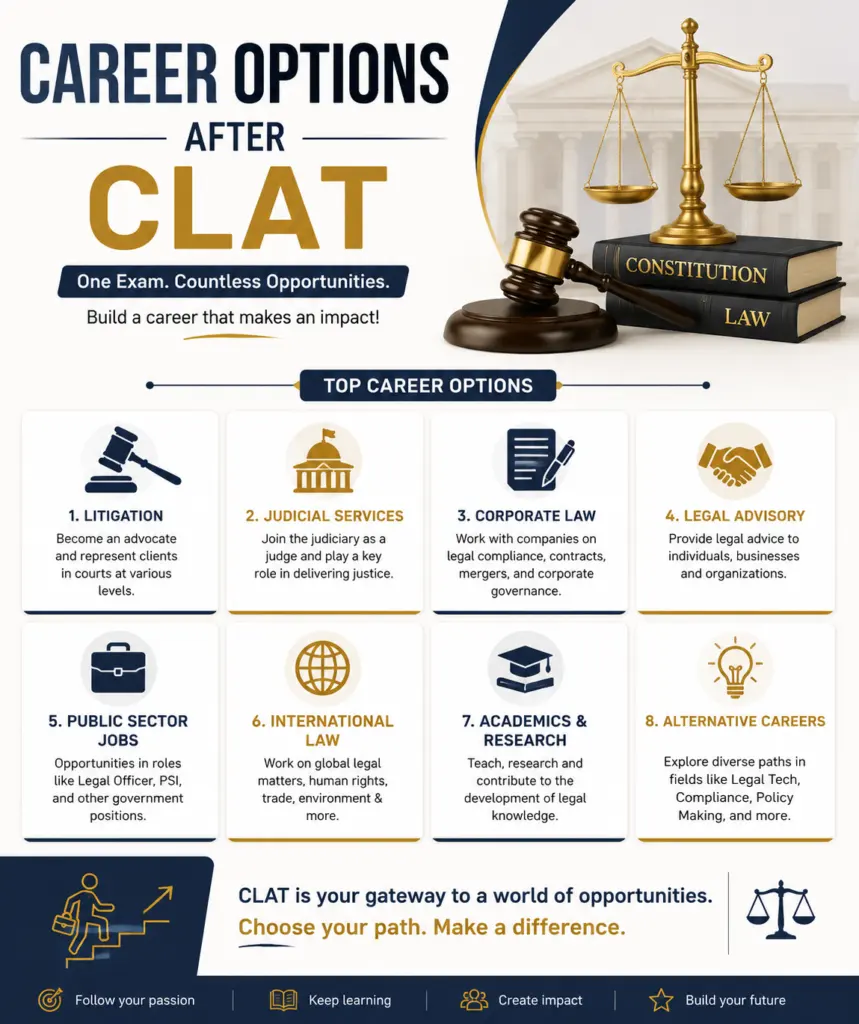
Every year, lakhs of aspirants pour months of preparation into cracking the Common Law Admission Test, treating the exam itself as the finish line. But CLAT is a gateway, not a destination. Once inside an NLU — or any law school that accepts CLAT scores — students discover that the legal profession has splintered into a wide array of specialisations, each with its own entry path, skill demands, and reward structure. This guide walks through those options in detail, so you can start planning your five years with the end goal in mind rather than figuring it out in the final semester.
Litigation remains the most visible and, for many, the most prestigious route in Indian legal practice. It involves representing clients in courts — from district courts and tribunals up to High Courts and the Supreme Court. Litigators build careers either independently, as juniors under a Senior Advocate, or as associates in litigation-focused law firms.
The path typically starts with a period of “juniorship,” where fresh graduates work under an established advocate for modest stipends while learning drafting, court procedure, and client handling. It is slow-burning: meaningful independent practice and financial stability often take five to ten years to build. But the ceiling is extraordinarily high — Senior Advocates and top litigators command some of the highest fees in the profession.
Who should consider this
Students who enjoy public speaking, quick thinking under pressure, procedural law, and don’t mind a slower initial payoff in exchange for long-term autonomy and prestige.How to prepare for CLAT 2027 after class 11 in Easy way
Within litigation itself, the field splits further into specialisations such as constitutional and writ practice, criminal defence, civil and property disputes, matrimonial and family law, and increasingly lucrative niches like intellectual property litigation and white-collar crime defence. Many successful litigators spend their first few years deliberately rotating between different types of matters before settling into a niche where they can build genuine subject-matter depth. Networking, courtroom visibility, and consistent quality of drafting matter far more here than academic rank, which is part of why litigation rewards perseverance as much as pedigree.
This is the most sought-after track among NLU graduates, driven by campus placements and Pre-Placement Offers (PPOs). Tier-1 firms such as AZB & Partners, Cyril Amarchand Mangaldas, Shardul Amarchand Mangaldas, Khaitan & Co, Trilegal, and JSA recruit heavily from NLUs for practice areas like mergers and acquisitions, private equity, banking and finance, capital markets, and dispute resolution.
Corporate law offers structured career progression, strong starting compensation, and international exposure, but is also known for demanding work hours, especially during deal closings. Specialising early — through moot courts, internships, and elective choices in company law, taxation, and securities law — significantly improves placement outcomes.

The Judicial Services Examination, conducted separately by each state’s Public Service Commission or High Court, offers a route to becoming a Civil Judge (Junior Division), which can eventually lead to elevation as a District Judge and, in exceptional cases, to the High Court. Some states allow fresh law graduates to sit directly, while others require a minimum number of years of practice.
The judiciary offers job security, social respect, and a structured pension, but demands rigorous, syllabus-specific preparation covering CPC, CrPC, Evidence Act, and state-specific local laws, in addition to strong drafting skills tested in the mains examination.
A significant number of CLAT graduates pivot toward the Civil Services Examination conducted by UPSC, aiming for the IAS, IPS, IFS, and allied services, or toward state PCS exams. A law degree provides a natural advantage for the Law optional subject and for GS Paper II, which is heavily rooted in the Constitution, polity, and governance — territory law students already know well.
This path requires stepping outside conventional legal practice altogether, and demands dedicated preparation alongside or after the law degree, but rewards successful candidates with policy-making roles, administrative authority, and nationwide postings.
Rather than working at a law firm, many graduates join the in-house legal team of a corporation, bank, or start-up directly. In-house counsel manage contracts, compliance, regulatory filings, employment disputes, and coordinate with external law firms when litigation or specialised advice is needed.
This route generally offers better work-life balance than Big Law, closer engagement with business strategy, and, at senior levels (General Counsel), a seat in the company’s leadership team. Entry can happen straight out of campus placements for large corporates, but more commonly graduates spend two to four years at a law firm first, building the transactional or litigation expertise that makes them valuable as an in-house hire later. Start-ups and fast-growing companies particularly value in-house counsel who can wear multiple hats — handling everything from vendor contracts and employment policy to fundraising documentation and data-privacy compliance under India’s evolving digital laws.
India’s LPO sector, along with the rapidly growing LegalTech space, offers roles in contract review, legal research, e-discovery, and compliance support for international clients. Companies like CPA Global, Integreon, and a wave of AI-driven legal-tech start-ups hire law graduates for research-intensive, process-driven work.
LegalTech in particular is an emerging frontier — combining legal knowledge with technology skills to build contract-automation tools, AI-assisted research platforms, and compliance software, appealing to graduates interested in innovation over traditional practice.
With Indian courts overburdened, arbitration and mediation have grown into a specialised and lucrative niche. ADR practitioners work on domestic and international commercial arbitration, often collaborating with global arbitration institutions. This field rewards strong drafting, negotiation skills, and often international exposure through LLM specialisations or arbitration fellowships.
For those inclined toward teaching and scholarship, academia offers a path through an LLM followed by a Ph.D., leading to faculty positions at NLUs or other law schools. Legal research roles — working for judges as law clerks, or with think tanks and policy research organisations — are another respected avenue, often serving as a stepping stone toward academia, judiciary, or public policy work.
Legal training pairs naturally with public policy work — drafting legislation, advising parliamentary committees, or working with policy think tanks such as the Vidhi Centre for Legal Policy. This track suits graduates interested in shaping laws and regulatory frameworks rather than practising under them. Regulatory bodies such as SEBI, RBI, CCI, and TRAI also periodically recruit law graduates as legal officers or grade-A officers through dedicated examinations, offering a hybrid career that combines the analytical rigour of law with the authority of a regulator. For those who eventually clear the Civil Services Examination, a policy background built during law school often translates directly into more effective work in ministries dealing with legislative affairs, corporate affairs, or law and justice.
Graduates with an interest in international human rights, trade law, or diplomacy can pursue roles with the United Nations, WTO, international NGOs, or foreign law firms, typically after an LLM from a foreign university. This route requires strong academic credentials, moot court experience (especially in international moots like Jessup or Vis Moot), and often fluency in additional languages.
An increasing number of law graduates are founding start-ups — both legal and non-legal. Legal knowledge provides an edge in navigating regulatory approvals, contracts, and IP protection, and many founders leverage this to build LegalTech platforms, compliance SaaS products, or advisory boutiques of their own.
| Career Track | Entry Route | Initial Pace | Long-Term Ceiling |
|---|---|---|---|
| Litigation | Juniorship under Advocate | Slow | Very High |
| Corporate Law (Big Law) | Campus placement / PPO | Fast | High |
| Judiciary | Judicial Services Exam | Moderate | Stable, High Respect |
| Civil Services | UPSC / State PCS | Moderate | Very High (Policy Power) |
| In-House Counsel | Lateral hire / campus | Fast | High (as GC) |
| ADR / Arbitration | LLM + Fellowship | Moderate | High, Niche |
| Academia | LLM + Ph.D. | Slow | Moderate, Prestige-driven |
| International Law | Foreign LLM + Moots | Slow | High, Location-dependent |

High Demand
Deal-driven work at national law firms; strong starting packages via campus placement.
Stable
State-conducted exam; job security, pension, and a defined promotion ladder.
Prestige
Slow build, high autonomy; culminates in Senior Advocate designation for the successful few.
Policy Track
Law background aids GS Paper II and optional subject prep for the UPSC CSE.
Emerging
Combines legal expertise with product thinking to automate contracts and compliance.
Global
Requires an LLM and moot experience; handles cross-border commercial disputes.
“The five years at an NLU are not just about the degree — they’re about the internships, moots, and electives that quietly decide which of these fifteen doors will actually open for you.”
Across almost every one of these tracks, recruiters and seniors consistently point to a handful of practical skills that matter more than raw academic rank. Strong legal drafting — the ability to write a clear, persuasive contract clause or a tight legal opinion — is arguably the single most transferable skill in the profession, valued equally by litigators, corporate associates, and in-house teams. Research ability, particularly the discipline to trace a legal proposition back to primary sources rather than relying on secondary commentary, separates strong associates from average ones within the first year of practice.
Negotiation and client-communication skills, often underdeveloped in the classroom, become critical the moment you start handling real matters, whether that means explaining a settlement option to a nervous client or pushing back on an aggressive counterparty during a deal. Finally, comfort with technology — from e-discovery tools and AI-assisted research platforms to basic data analysis — is quickly becoming a baseline expectation rather than a differentiator, as law firms and in-house teams alike adopt legal-tech tools to speed up routine work.
Starting compensation varies dramatically by track, and managing expectations early avoids disappointment later. Tier-1 corporate law firms typically offer the highest fresher salaries among all legal careers, particularly for graduates from the top NLUs recruited through campus placements. In-house roles at large corporates and start-ups often start slightly lower than Big Law but narrow the gap quickly with bonuses, ESOPs, and faster designation growth. Judicial services offer modest but stable government pay scales with defined allowances and pension benefits, while independent litigation offers little to no guaranteed income in the first two to three years, compensated for later by fee-based earning potential that can eventually exceed every other track. Civil servants selected through UPSC receive standard government pay bands along with the intangible value of administrative authority and nationwide impact, which many graduates weigh as being worth more than the salary difference alone.
The right career after CLAT depends on three honest self-assessments:
Use the first two years of law school to sample widely — intern at a litigation chamber, a corporate firm, an NGO, and a policy think tank before narrowing down. Moot court participation builds oral advocacy and research skills valuable across almost every track, while writing for law journals strengthens academic and policy-oriented profiles.
It also helps to talk to alumni who are three to five years into each of these careers rather than relying only on campus perception, since placement season tends to glamorise corporate law disproportionately while understating how rewarding litigation, judiciary, or civil services can become once the initial slow years are behind you. Building a small personal board of mentors across two or three different tracks — a senior litigator, a corporate partner, a sitting judge, or a civil servant — gives far more realistic, lived-in guidance than any single source of advice, including this one.
No. It’s the most visible due to campus placements, but litigation, judiciary, and civil services offer equally rewarding — sometimes more prestigious — long-term outcomes, just on a different timeline.
Yes. A law degree is a recognised qualifying degree for UPSC CSE, and Law is also available as an optional subject, giving law graduates a natural preparation advantage.
Not always, but for academia, international law, and arbitration specifically, an LLM (often from a foreign university for the latter two) significantly strengthens prospects.
You don’t need certainty in year one. Most successful graduates keep exploring through internships until the third or fourth year, then specialise through electives, moots, and targeted internships in the final two years.
The legal profession in India today offers far more breadth than the courtroom-versus-corporate binary most aspirants imagine while preparing for CLAT. Whichever path you lean toward, the underlying advice stays the same: use your law school years deliberately, seek varied internship exposure early, and let real experience — not just prestige or peer pressure — guide your final choice.
Explore our complete CLAT preparation guides — syllabus breakdowns, Legal Reasoning strategy, and subject-wise prioritisation. © 2026 · Career Guidance Series · For educational purposes