

CA & GK
AI Is Now Minting Billion-Dollar Companies Faster Than Ever
The startup world just crossed a new milestone. According to the Hurun Global Unicorn Index 2026, released by the Hurun Research Institute
5 min read

CLAT 2027 · GK & Current Affairs
CLAT’s GK section is passage-based, not fact-recall — so knowing which stories carry legal and constitutional weight matters more than memorising headlines. Here’s the shortlist worth your time.CLAT 2027: Most Important Current Affairs
📅 Coverage window: Jan 2026 – Nov 2026🎯 Exam: CLAT UG 2027, Dec 2026
~25%Weight of GK & CA section
35–39Questions from this section
450Words per passage
11Months of CA tested (approx.)
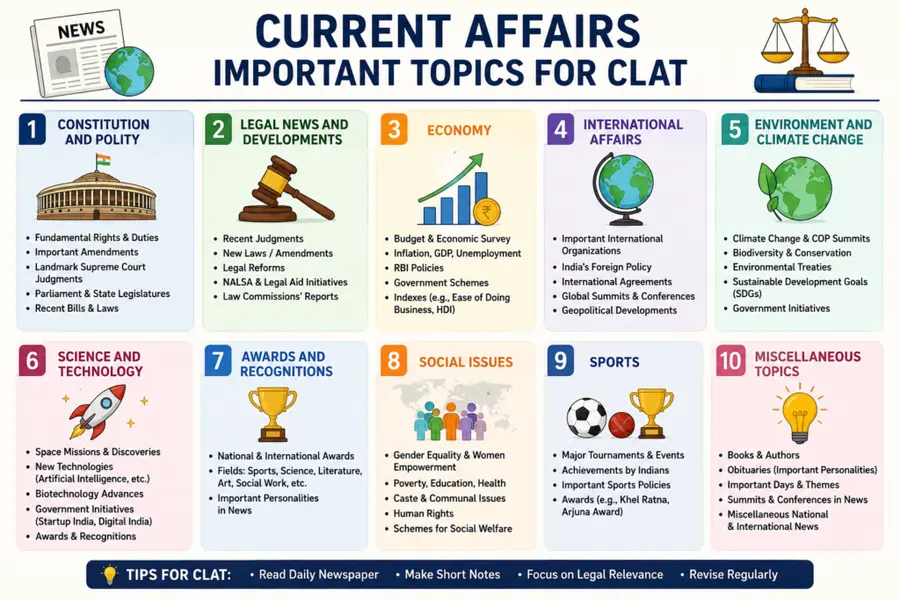
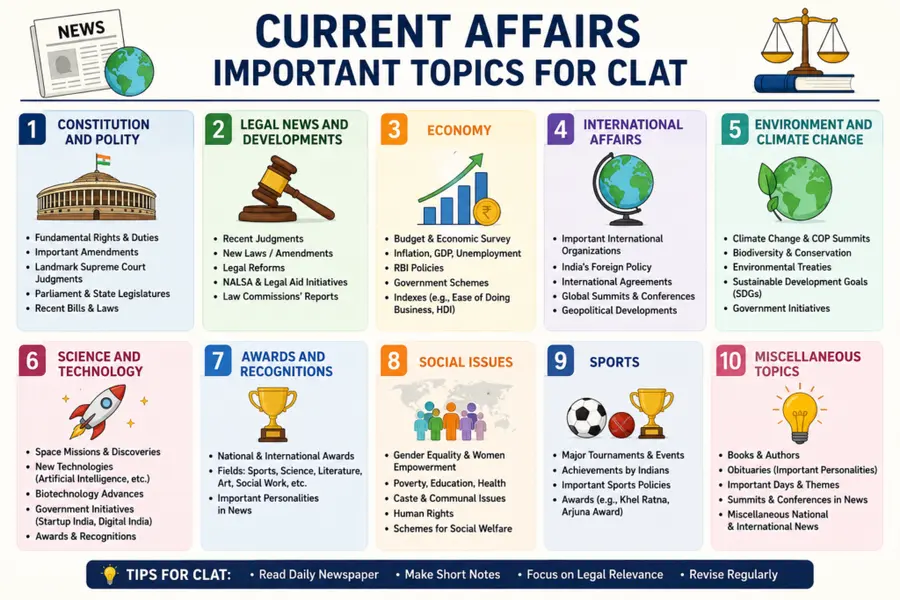
CLAT does not ask “who won what” — it hands you a 450-word passage built from a real news event and tests whether you can extract the legal or constitutional angle inside it. That’s why the topics below are chosen not for how loud they were in the news, but for how directly they connect to polity, rights, governance, or law. Read each one with the question “what would a CLAT passage ask me from this?” in mind.
These stories double up — they can appear as GK passages and feed directly into Legal Reasoning principles, so mastering them is a two-birds move.CLAT 2027: Most Important Current Affairs
Judiciary
The Supreme Court’s 2026 clarifications on “bail is the rule, jail is the exception” under UAPA reaffirm that personal liberty under Article 21 cannot be diluted by statute, and that larger-bench rulings bind smaller benches.
Why it matters: tests fundamental rights + doctrine of precedent together.
Judiciary
Recent rulings held that functional disability affecting a person’s actual trade (a mason, a carpenter) can be assessed higher than the medical disability percentage, reshaping compensation under the Motor Vehicles Act.
Why it matters: classic law-of-torts passage with a real fact pattern.
Governance
The Association for Democratic Reforms’ analysis of declared criminal cases among Rajya Sabha members has revived the debate on electoral reform, disclosure norms, and the Representation of the People Act.ADR Report: Criminalisation in the Rajya Sabha is important
Why it matters: links electoral law with governance ethics — a Consortium favourite.CLAT 2026 UG Syllabus
Judiciary
The Supreme Court’s 2026 rulings sharpened the scope of benami transactions and evidentiary standards, relevant to property law and anti-corruption enforcement.
Why it matters: connects statutory interpretation with property rights.
100+ Essential Legal Terms for CLAT 2026 | Complete Glossary
Elections
The Special Intensive Revision of electoral rolls, upheld amid litigation over exclusion of voters, keeps the balance between administrative efficiency and the right to vote in focus.
Judiciary
The judiciary’s own framework for AI use in courts — covering transparency, human oversight, and data protection — is a first-of-its-kind governance document worth knowing cold.
Federalism
Continuing disputes over assent to state bills and gubernatorial discretion keep testing the boundaries of Articles 200 and 201.
Rights
A Supreme Court-directed national protection framework for trafficking survivors strengthens rights-based enforcement beyond mere prosecution.
Trade
India’s expanding web of trade agreements with the UK, UAE, and EFTA bloc, plus the India–US Interim Trade Framework, shapes tariff policy and market access.
Neighbourhood
Lipulekh and Susta remain unresolved flashpoints that test India’s neighbourhood-first diplomacy against domestic political pressure in Nepal.
Diplomacy
A rare diplomatic breakthrough with implications for West Asian stability, oil markets, and India’s strategic balancing act in the region.
Multilateral
Track India’s positioning within shifting multilateral blocs — these bodies are a recurring source of CLAT passages on global governance.
Economy
Revised IMF figures repositioning India’s global GDP rank triggered debate on growth sustainability, currency valuation, and fiscal policy direction.
Industry
A flagship scheme for planned industrial infrastructure — useful for questions linking government schemes to manufacturing and employment policy.
Environment
India’s wetland conservation network expanding past 100 Ramsar sites strengthens its environmental diplomacy credentials ahead of global climate summits.
Climate
India’s ethanol blending targets and the evolving carbon credit market intersect energy policy with climate ethics — a favourite editorial theme.

| Category | Topic | Legal/Exam Angle |
|---|---|---|
| Judiciary | UAPA bail jurisprudence | Article 21, doctrine of precedent |
| Judiciary | Benami property clarifications | Property law, statutory interpretation |
| Elections | ADR report on criminalisation, Rajya Sabha | Representation of the People Act |
| Elections | Special Intensive Revision of rolls (Bihar) | Right to vote, Article 326 |
| Governance | Supreme Court Draft AI Regulations 2026 | Data protection, judicial administration |
| Federalism | Governor–state assent disputes | Articles 200, 201 |
| International | CETA, CEPA, TEPA, India–US trade framework | Trade law, tariff policy |
| International | India–Nepal boundary disputes | Territorial sovereignty, treaties |
| International | US–Iran peace MoU | International relations, energy security |
| Economy | IMF GDP ranking revision | Fiscal policy, macroeconomics |
| Economy | BHAVYA industrial parks scheme | Government schemes, industrial policy |
| Environment | Ramsar sites crossing 100 | Environmental law, conservation treaties |
| Environment | Ethanol blending & carbon credits | Climate policy, energy law |
| Social Justice | Human Trafficking Victim Protection Plan | Rights-based enforcement |
Q1. The Supreme Court’s 2026 ruling on UAPA bail reaffirmed that the principle “bail is the rule, jail is the exception” flows primarily from which constitutional provision?
Show Answer & Explanation
Correct answer: C — Article 21. The Court clarified that this principle is rooted in the constitutional primacy of personal liberty under Article 21, and therefore cannot be displaced by ordinary legislation such as UAPA’s stringent bail conditions.
Q2. India crossing 100 Ramsar sites in 2026 is most directly relevant to which international framework?
Show Answer & Explanation
Correct answer: B — Ramsar Convention on Wetlands. Ramsar sites are wetlands designated as internationally important under the 1971 Ramsar Convention, not under carbon-emission treaties like Kyoto or Paris.
Q3. The ADR report on criminalisation in the Rajya Sabha is most closely tied to reforms under which legislation?
Show Answer & Explanation
Correct answer: B — Representation of the People Act, 1951. Disclosure of criminal antecedents by candidates and members is governed under this Act, and ADR’s reports are typically used to push for stricter disclosure and disqualification norms under it.
Q4. CETA, signed by India, refers to a trade agreement with which country/bloc?
Show Answer & Explanation
Correct answer: C — United Kingdom. The Comprehensive Economic and Trade Agreement (CETA) is India’s trade pact with the UK; UAE and Australia are covered under CEPA and ECTA respectively.
Coming next: a dedicated deep-dive on Supreme Court judgments of 2026 with CLAT-style passage practice — useful for both GK and Legal Reasoning sections. Prepared for CLAT 2027 aspirants · Current affairs coverage current as of end-June 2026
Why Current Affairs Matter for CLAT | Complete Guide
CLAT 2027 • Current Affairs
Current affairs isn’t a side subject for CLAT — it decides how well you score in GK, how sharply you reason in Legal Reasoning, and how confidently you write your essays. Here’s the complete picture.
25GK & CA Questions
~17%Weight in CLAT Paper
120Total Questions
2 hrsExam Duration
Every year, CLAT toppers say the same thing in hindsight: “I lost marks not because I didn’t know law, but because I hadn’t read enough.” Current affairs is the one section where consistent daily habit beats last-minute cramming — and it quietly touches almost every other section of the paper too.
The CLAT English and General Knowledge section devotes a substantial chunk of its 120 questions to passage-based current affairs — usually built around a news event from the past 12 months, followed by comprehension-style questions on facts, context, and implications. Unlike Legal Reasoning or Logical Reasoning, where you need to apply a principle, GK questions test whether you actually read the news. That makes it one of the most reliable sections to secure marks in, provided you’ve been consistent.
CLAT’s Legal Reasoning passages are increasingly drawn from real, recent legal developments — Supreme Court judgments, new legislation, constitutional amendments, regulatory changes. A candidate who has followed a case in the news will read the passage faster, understand the legal principle in context, and avoid misreading unfamiliar terminology under time pressure. Current affairs, in this sense, is a comprehension shortcut disguised as a GK habit.
01
Familiar context means less time spent decoding what a passage is even about.
02
You can spot what’s implied vs. stated because you already know the background.
03
Real examples from current events make Mains-style and personal statement writing sharper.
04
National Law University interviews often open with “what’s happening in the news right now.”
CLAT shifted years ago from a memory-based exam to a comprehension-and-reasoning-based one. This means current affairs preparation should never be reduced to memorising dates and names. The exam rewards candidates who can explain why an event matters — its cause, its stakeholders, and its consequence. Reading a report on, say, criminalisation in the Rajya Sabha isn’t useful because you memorise the percentage figure; it’s useful because you understand what it says about representation, electoral reform, and institutional accountability — themes that resurface across GK, essay, and interview rounds.
A well-prepared candidate treats current events as an entry point into static knowledge. A news story on a new government scheme naturally pulls in constitutional provisions, historical background, and related previous schemes. This layered reading is far more efficient than treating static GK and current affairs as separate silos.
| Current Affairs Theme | Connects to Static GK | CLAT Section Impact |
|---|---|---|
| Supreme Court judgments | Fundamental Rights, DPSPs | Legal Reasoning, GK |
| New legislation / bills | Legislative process, Parliament | Legal Reasoning, GK |
| International relations events | Foreign policy history | GK, Essay/Interview |
| Economic policy news | Five-Year Plans, budget basics | GK |
| Environmental reports | Constitutional environmental provisions | GK, Essay |
CLAT typically draws current affairs questions from roughly the preceding 12 months. That means a candidate who starts reading news seriously only two months before the exam is trying to compress a year’s worth of context into a sprint — and it shows in shallow, disconnected answers. Aspirants who build a daily or weekly habit — reading a curated digest, noting down key facts, and revising monthly — retain information far better because each new story builds on ones they’ve already processed.
Candidates who deprioritise current affairs typically hit two problems on exam day. First, they lose easy, direct marks in the GK section — marks that require no reasoning, only preparation. Second, and less obviously, they slow down in Legal Reasoning because unfamiliar real-world context forces them to build understanding from scratch under time pressure, while better-prepared peers move straight to answering. In an exam decided by minutes and marginal accuracy, that gap compounds quickly.
Practice MCQ: Which of the following best explains why current affairs preparation improves Legal Reasoning performance in CLAT?
Correct Answer: B — Prior familiarity with a news event lets candidates focus on applying the legal principle rather than decoding unfamiliar context.
“Current affairs preparation is as important for CLAT as knowledge of legal principles.” Discuss.
Current affairs preparation is integral to CLAT success, not merely supplementary to legal knowledge. Structurally, the exam devotes a significant share of its 120 questions to GK and current affairs, making it one of the most direct, scoring sections available to a well-prepared candidate. Beyond this direct weightage, current affairs preparation has a multiplier effect across the paper. CLAT’s Legal Reasoning section increasingly draws passages from real judicial pronouncements, legislative changes, and policy developments; a candidate already familiar with the underlying event reads faster, infers more accurately, and applies legal principles with greater confidence than one encountering the context for the first time under exam pressure.
Current affairs also anchors static knowledge. Reading about a contemporary policy or judgment naturally revisits constitutional provisions, institutional structures, and historical precedent, reinforcing static GK more effectively than isolated memorisation. This layered understanding extends beyond the written exam into personal interviews at National Law Universities, where panels frequently probe a candidate’s awareness of and opinion on recent developments.
Consequently, current affairs and legal knowledge are not competing priorities but complementary ones. A candidate who reads consistently over an extended period — rather than cramming in the final weeks — builds the contextual fluency that CLAT’s comprehension-driven format rewards, making current affairs preparation a foundational, not optional, part of exam strategy.
Consistent, focused reading beats last-minute cramming every time — start your current affairs routine today.
The startup world just crossed a new milestone. According to the Hurun Global Unicorn Index 2026, released by the Hurun Research Institute
Introduction Ask any CLAT topper what habit made the biggest difference to their preparation, and nine times out of ten, “reading the…
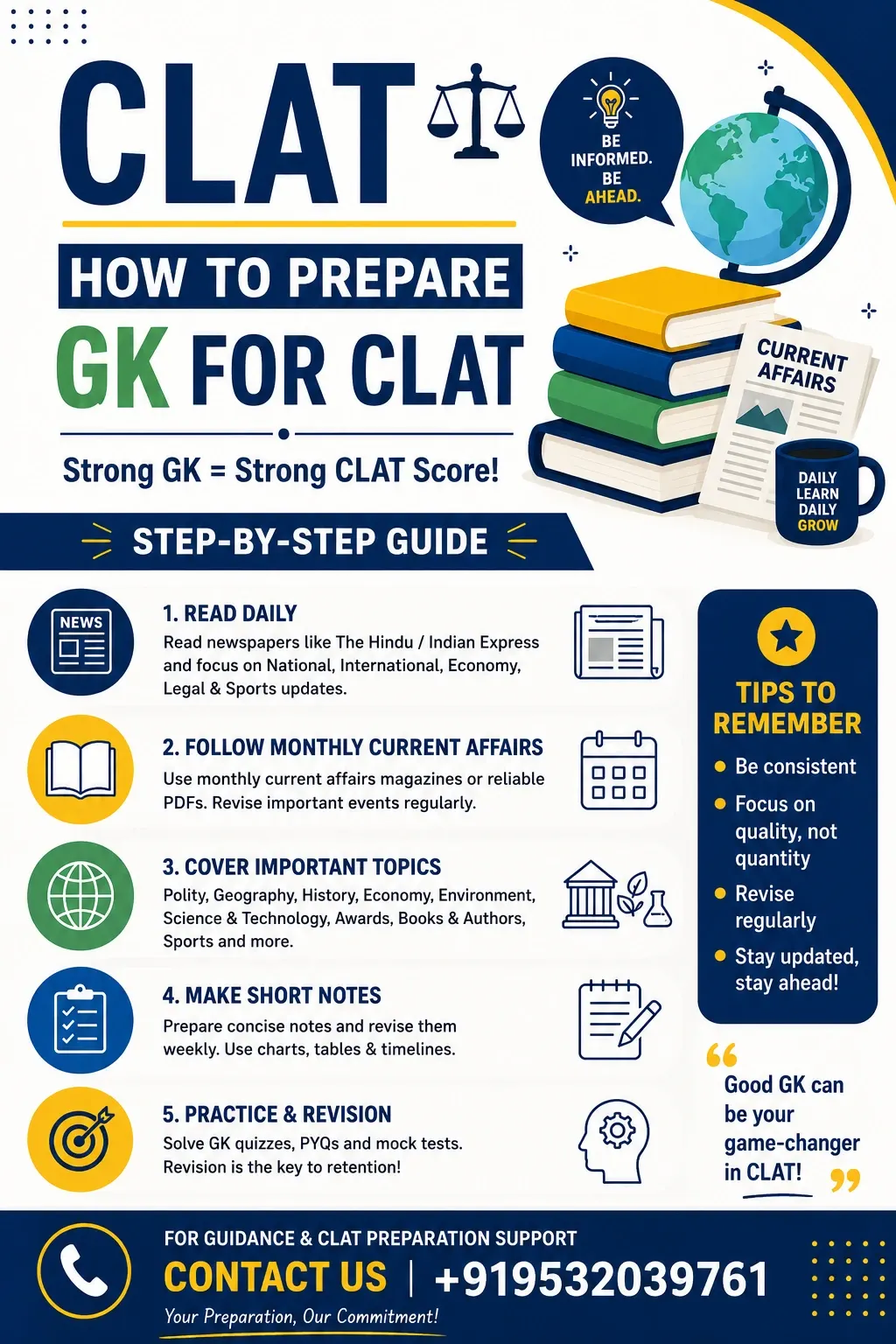
CLAT Prep Series · General Knowledge & Current Affairs · 2026 Complete Strategy Guide How to Prepare GK for CLAT From daily newspaper…