Resource
Test Blog
8 min read
The Consortium of National Law Universities (NLUs) has released the official CLAT 2027 notification, marking the formal start of the admission cycle for one of India's most competitive law entrance exams. With 27 National Law Universities and 60+ affiliated law schools accepting CLAT scores for admission to the 5-year integrated LLB and LLM programmes, lakhs of aspirants across the country will be gearing up for this exam. Here's everything you need to know — dates, registration, syllabus, and exam pattern — in one place.
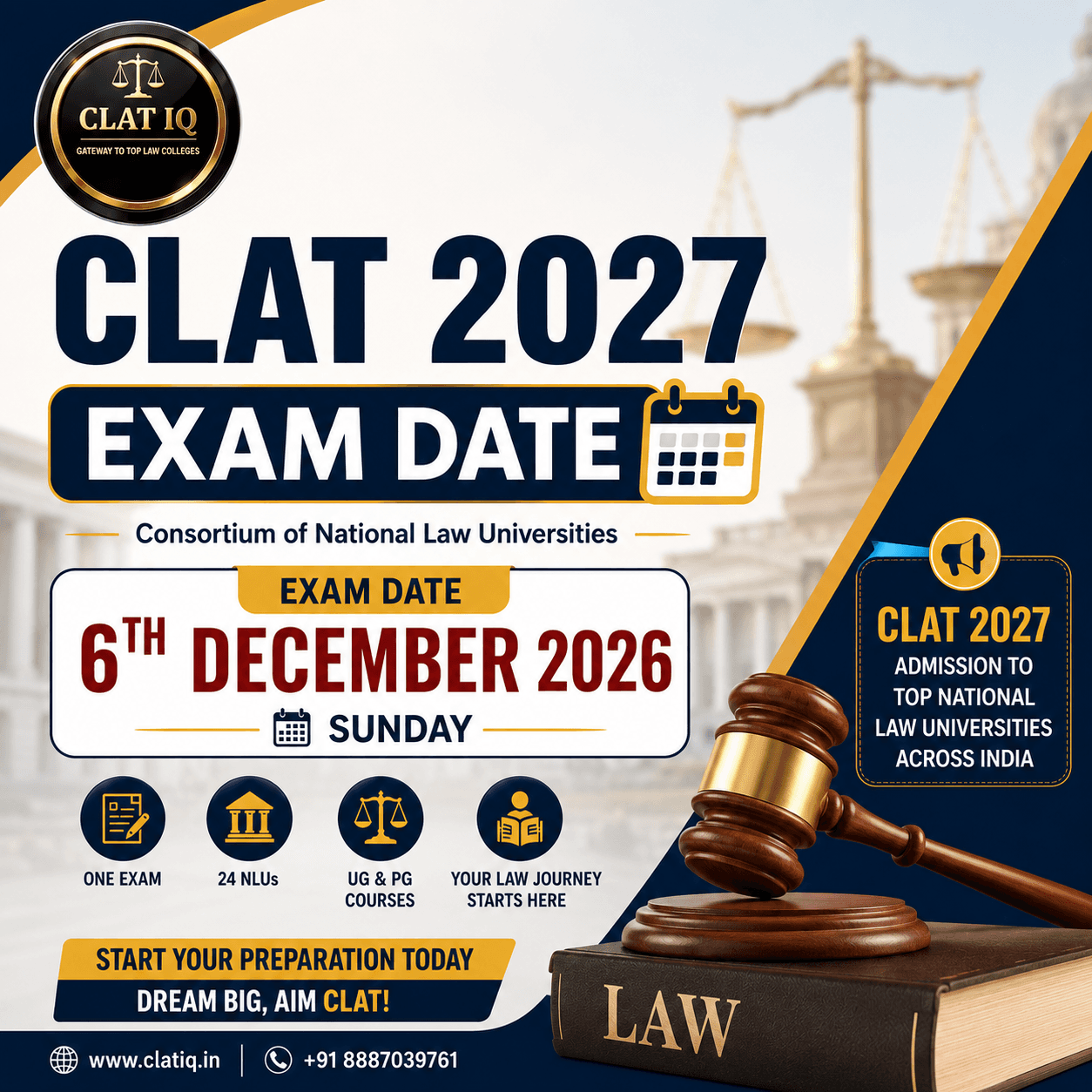
The official CLAT 2027 notification was released on 22 July 2026, with registration set to begin on the Consortium of NLUs website from 3rd August 2026.The exam remains the gateway to 27 National Law Universities across India.
Importantly, the syllabus and pattern for both the UG and PG papers remain unchanged for CLAT 2027, with paper setters expected to adopt the Expert Committee's suggestions on question format and quality only where feasible A CLAT Expert Committee Report has also been published on the Consortium's website, and public feedback on it can be submitted through an online form until 31 August 2026 — though any resulting changes are expected to apply from CLAT 2028 onward, not this cycle
Event Date Release of official notification 22 July 2026 Start of online registration 3 August 2026 Last date to submit application Last week of October 2026 (as per schedule) Application correction window To be announced Release of admit card Around 2–3 weeks before the exam CLAT 2027 exam date Sunday, 6 December 2026 Exam timing 2:00 PM – 4:00 PM Result declaration 3rd week of December 2026 (expected) Start of counselling Soon after result declaration
Around 92,344 candidates appeared for CLAT last year, including 75,009 for UG and 17,335 for PG, and this number is expected to cross 1 lakh applicants this year.</cite> <cite index The application fee is ₹4,000 for General/OBC candidates and ₹3,500 for SC/ST/BPL/PwD candidates.
Visit the official website: consortiumofnlus.ac.in
Go to the Notifications / CLAT 2027 section
Click on the Notification PDF and download it
Carefully check exam date, registration window, eligibility, syllabus/pattern, and counselling details before applying
No upper age limit for either the UG or PG programme.
Students appearing for their 10+2 examination in the 2026–27 academic session are also eligible to apply for CLAT 2027 UG.
Candidates awaiting final results of their qualifying examination can also apply, subject to confirmation of eligibility at the time of admission.
The CLAT 2027 UG exam will be conducted in offline (pen-and-paper) mode, consisting of 120 passage-based multiple-choice questions, with a duration of 2 hours.Each correct answer earns +1 mark, and 0.25 marks are deducted for every incorrect answer there is no penalty for unattempted questions.
Parameter Details Mode Offline (pen and paper) Duration 2 hours (120 minutes) Type of questions Objective (MCQ), passage-based Number of questions 120 Total marks 120 Marking scheme +1 for correct, −0.25 for incorrect Medium English
CLAT UG has five sections — English, Current Affairs & GK, Legal Reasoning, Logical Reasoning, and Quantitative Techniques.Current Affairs & GK and Legal Reasoning together contribute roughly 50% of the total paper, making them the biggest rank-deciders.The English Language section typically comprises around 22–26 questions testing grammar, vocabulary, and comprehension.
Section Approx. Weightage English Language ~20% Current Affairs & General Knowledge ~25% Legal Reasoning ~25% Logical Reasoning ~20% Quantitative Techniques ~10-13%
(Exact question-wise distribution should always be cross-checked against the official notification PDF, as minor variations are possible.)
All questions are drawn from reading passages — direct factual recall has been eliminated, and the exam tests comprehension and reasoning rather than rote memory This makes reading speed and comprehension accuracy critical. As a preparation strategy, smartly attempting 85–95 questions with high accuracy tends to work better than attempting all 120 with guesswork,given the negative marking.
The CLAT PG programme also consists of 120 MCQs to be answered in 120 minutes, based on comprehension passages.Questions are drawn from Constitutional Law and other law subjects, with passages of roughly 450 words each followed by 4–5 questions.Unlike the UG paper, the CLAT PG question paper is not divided into fixed, labelled sections.
Parameter Details Mode Offline (pen and paper) Duration 2 hours Number of questions 120 Total marks 120 Marking scheme +1 for correct, −0.25 for incorrect
The CLAT PG syllabus draws from core LLB subjects, including Constitutional Law, Jurisprudence, and other law subjects studied during the undergraduate law degree, unlike CLAT UG, which tests general aptitude and reasoning.
Reading comprehension passages (based on contemporary fiction/non-fiction) followed by questions on:
Meaning of words/phrases in context
Inference and conclusions drawn from the passage
Summarising and understanding the main point/theme
Grammar and correction of errors
Passages based on news, journalistic sources, and non-fiction writing, covering:
National and international current affairs
Contemporary events of legal/constitutional significance
Static GK relevant to recent developments
Arts and culture, international affairs, and historical events of contemporary relevance
Passages relating to legal and moral issues/judgments, testing:
Application of legal principles/rules to given facts
Issues in contemporary legal and public policy
Constitutional law and its practical application
General/well-known legal principles (no specialised legal knowledge required)
Passage/argument-based questions testing:
Identifying arguments, premises, and conclusions
Analogies, logical sequences, and syllogisms
Critical reasoning and assumption-based questions
Short sets/passages with numerical/graphical information, testing:
Derivation of proportions, ratios, and basic data interpretation
Elementary mathematics (up to Class 10 level)
Prioritise Current Affairs & Legal Reasoning — together they make up half the paper, so consistent daily reading of editorials and legal news pays off.
Practice with full-length mocks under timed, exam-like conditions to build stamina for the passage-heavy format.
Focus on accuracy over attempts — with negative marking, a measured approach beats attempting every question.
Track the official notification regularly for updates on registration correction windows, admit card release, and any procedural changes.
Revise systematically — allocate fixed weekly hours to each section rather than studying reactively.
Q1. When is the CLAT 2027 exam? CLAT 2027 will be conducted on Sunday, 6 December 2026.
Q2. When did the CLAT 2027 notification release? The official notification was released on 22 July 2026.
Q3. When does registration start? Registration begins on the Consortium of NLUs website from 3 August 2026.
Q4. Has the syllabus changed for CLAT 2027? No — the syllabus and pattern for both UG and PG papers remain unchanged for CLAT 2027. Any reform recommendations from the Expert Committee are expected to apply from CLAT 2028 onward.
Q5. What is the total number of questions and marks? Both CLAT UG and CLAT PG consist of 120 questions carrying 120 total marks, with a 2-hour duration.
Q6. Is there negative marking? Yes — 0.25 marks are deducted for every incorrect answer, with no penalty for unattempted questions.
This article will be updated as further official details — including the correction window, admit card date, and counselling schedule — are announced by the Consortium of NLUs. Aspirants are advised to cross-check all information against the official notification PDF at consortiumofnlus.ac.in.