Resource
Test Blog
8 min read
The Common Law Admission Test (CLAT) is one of the most competitive entrance exams in India, opening doors to the country's premier National Law Universities (NLUs). With lakhs of aspirants competing for a limited number of seats, a generic preparation approach simply won't cut it. What separates a top-100 ranker from an average scorer is often not raw intelligence, but a smart, section-wise strategy that plays to the exam's unique demands.
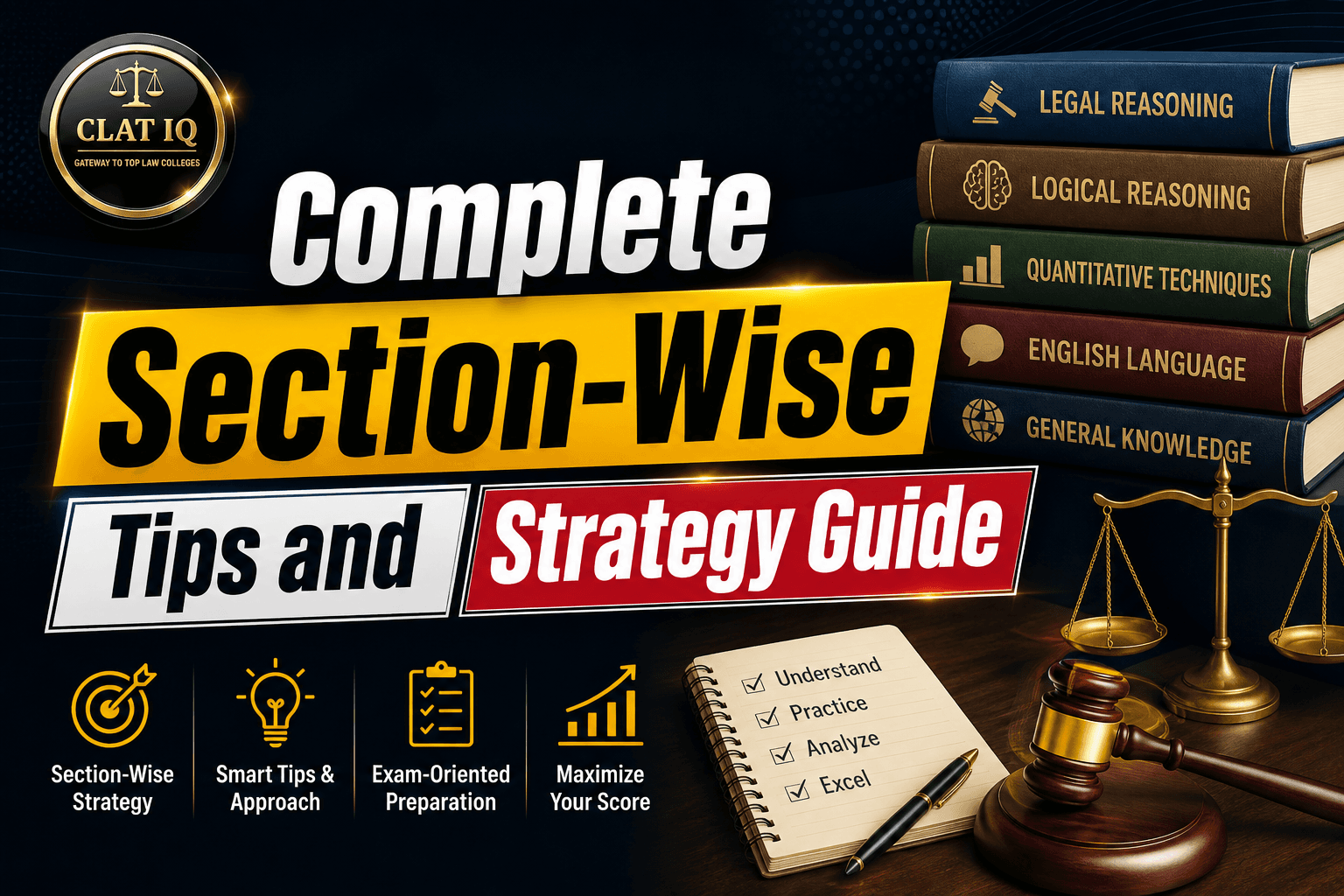
CLAT tests five core areas: English Language, Current Affairs including General Knowledge, Legal Reasoning, Logical Reasoning, and Quantitative Techniques. Each section has its own rhythm, its own traps, and its own shortcuts to mastery. In this guide, we break down practical, actionable tips for every section, along with time-management strategies and common mistakes to avoid.
Before diving into section-specific tips, it helps to understand the broad shape of the exam. CLAT is a passage-based, comprehension-heavy test. Nearly every question is built around a passage of 400-450 words, followed by a set of questions that test your ability to read, understand, infer, and apply logic — not simply recall facts. This is a crucial shift from traditional rote-learning exams, and your preparation must reflect that.
The test is objective, multiple-choice, and computer-based (for the UG CLAT), conducted with negative marking for wrong answers. Speed and accuracy both matter, but given the passage-based format, reading speed combined with comprehension accuracy becomes the single biggest differentiator between candidates.
With that context in mind, let's go section by section.
The English section in CLAT is not a test of grammar rules in isolation. Instead, it presents passages drawn from contemporary fiction, non-fiction, journalistic pieces, and academic writing, and asks questions on comprehension, inference, the author's tone and viewpoint, vocabulary in context, and summarization.
Read widely and read daily. The single best long-term strategy is to build a genuine reading habit at least four to six months before your exam. Read editorials from national newspapers, long-form journalism, and literary fiction. The goal isn't just vocabulary building — it's training your brain to process unfamiliar writing styles quickly.
Practice active reading, not passive reading. When you read a passage, don't just let your eyes glide over it. Ask yourself: What is the author's main argument? What tone are they using — critical, neutral, celebratory? What assumptions are they making? This active engagement is exactly what CLAT questions test.
Master the art of paraphrasing. Many questions ask you to identify which option best restates a sentence or idea from the passage. Practice rephrasing complex sentences in your own words after reading them. This skill directly translates into faster, more accurate answers.
Don't ignore vocabulary, but don't over-rely on rote lists either. CLAT vocabulary questions are almost always contextual — you need to guess the meaning of a word based on how it's used in the passage, not from a memorized word list. That said, having a base vocabulary of 500-700 commonly tested words (through root-word learning, not brute memorization) still helps you move faster.
Time yourself on passages. Aim to read a 450-word passage and answer its questions within 5-6 minutes. Practice this daily with a stopwatch. Initially, you'll be slow — that's expected. Speed comes with volume of practice, not shortcuts.
Learn to eliminate rather than select. In inference-based questions, at least two of the four options are usually extreme, out of scope, or factually wrong. Train yourself to eliminate these first rather than searching for the "perfect" right answer directly.
Common mistake to avoid: Many students overthink comprehension questions by bringing in outside knowledge or personal opinions. CLAT wants answers based strictly on what's written in the passage — nothing more, nothing less.
This section usually carries significant weightage and covers a passage-based format similar to English, but drawing on news events, legal developments, international relations, government policies, sports, awards, and static GK. Some passages may resemble short journalistic reports followed by factual and analytical questions.
Build a daily newspaper habit — and stick to it religiously. Reading one good English newspaper daily (editorial and national/international news sections) for the 12 months leading up to your exam is non-negotiable. Consistency matters more than reading three newspapers occasionally.
Maintain monthly current affairs notes. Don't just read passively — summarize important news in your own words in a notebook or digital document. Organize by category: Legal & Constitutional developments, National news, International relations, Sports, Awards & Honours, Science & Technology, Government schemes. This structured revision material becomes gold in the final months before the exam.
Prioritize legal and constitutional current affairs. Since CLAT is a law entrance exam, questions related to Supreme Court judgments, new legislation, constitutional amendments, and legal terminology in the news are asked more frequently and carry more predictive weight than generic trivia.
Use monthly compilations strategically. Instead of trying to remember every single news item from a 12-month period, rely on curated monthly or quarterly current affairs compilations closer to the exam for quick revision. Use your own notes as the primary source and compilations as backup.
Don't neglect static GK entirely. While CLAT leans heavily toward current affairs, a baseline of static GK — important historical dates, geography, government structure, sports records — helps you answer background-context questions embedded within passages.
Practice passage-based GK questions, not just factual recall. Since CLAT frames GK in a passage format, practice answering questions that ask you to infer the significance of an event or identify related facts, not just plain recall-based MCQs.
Revise in cycles. Current affairs are forgotten quickly if not revisited. Use a simple revision cycle: read something new, revise it after 3 days, then again after 2 weeks, then again a month later. This spaced repetition dramatically improves retention.
Common mistake to avoid: Students often cram current affairs in the final month and forget everything under exam pressure. Start early, revise consistently, and treat this section as a marathon, not a sprint.
This is arguably the most important section for a law aspirant, and often the most rewarding once you understand its pattern. It presents legal passages — principles, facts, or short case-based scenarios — and tests your ability to identify legal principles, apply them to hypothetical facts, and reach logical conclusions. Importantly, you do not need prior knowledge of law to do well here; the section is designed to test aptitude and reasoning, not memorized legal knowledge.
Understand that legal reasoning is applied logic, not legal knowledge. Many beginners panic thinking they need to know law. In reality, CLAT gives you the legal principle within the passage itself. Your job is to apply that principle correctly to the given facts — nothing more.
Practice the "principle-fact-application" method. For every legal reasoning question, mentally break it into three parts: What is the principle stated? What are the facts of the scenario? Does applying the principle to these facts logically lead to the given conclusion? This structured approach prevents you from getting swayed by emotionally persuasive but legally incorrect options.
Be wary of "almost right" answers. Legal reasoning options are often designed so that two choices seem plausible. The correct answer is the one that follows most strictly and literally from the stated principle — not the one that seems fair, moral, or common-sense. This is a crucial mindset shift: think like a strict rule-applier, not a judge weighing fairness.
Don't let real-world legal knowledge mislead you. If you already know some law (perhaps from coaching or reading), be careful not to apply outside legal knowledge that contradicts the principle given in the passage. CLAT wants you to apply only what's written, even if it differs slightly from actual law.
Build familiarity with recurring legal themes. Over time, you'll notice recurring themes: contract law basics, tort law (negligence, strict liability), criminal law principles (intention, criminal liability), constitutional law (fundamental rights), and family law fundamentals. Solving past years' papers will help you recognize these patterns quickly.
Practice under time pressure specifically for this section. Legal reasoning passages often take longer to process because of unfamiliar terminology and nuanced facts. Dedicate focused practice sessions where you solve 15-20 legal reasoning questions within a fixed time limit to build speed alongside accuracy.
Read landmark judgments in simplified form. While you won't be tested on case law directly, having a general sense of how courts reason (through simplified summaries of landmark judgments) builds valuable intuition for how legal logic flows.
Common mistake to avoid: Overanalyzing or second-guessing yourself. Once you've correctly identified the principle and matched it to the facts, trust your first well-reasoned answer rather than flip-flopping between options.
This section evaluates your ability to identify patterns, understand arguments, spot logical fallacies, draw inferences, and evaluate the strength of reasoning presented in short passages or argument-based questions. Unlike traditional logical reasoning tests with puzzles and seating arrangements, CLAT's logical reasoning is largely passage- and argument-based.
Focus on argument-based reasoning, not puzzle-solving. CLAT typically avoids heavy quantitative puzzles like circular seating arrangements or blood relations in complex forms. Instead, expect questions on identifying assumptions, conclusions, strengthening/weakening arguments, and spotting logical inconsistencies.
Learn to distinguish between premises and conclusions. A strong first step for any argument-based question is identifying: What is being claimed (the conclusion)? What evidence or reasoning supports it (the premises)? This separation makes it much easier to evaluate whether an option strengthens, weakens, or is irrelevant to the argument.
Master the core question types. The most frequently tested formats are: assumption identification, conclusion drawing, strengthening/weakening arguments, identifying logical fallacies, and cause-and-effect reasoning. Practice each type separately until you can identify the question type within seconds of reading it.
Be careful with "strengthen vs. weaken" questions. A common trap is choosing an option that is simply "related" to the argument without actually strengthening or weakening the specific logical link between premise and conclusion. Always ask: does this option affect the reasoning itself, not just the topic?
Practice identifying logical fallacies. Common fallacies tested include circular reasoning, false cause (correlation mistaken for causation), hasty generalization, and appeal to authority. Familiarity with these patterns helps you spot flawed arguments quickly.
Avoid overthinking simple arguments. Logical reasoning passages are usually short and self-contained. Resist the urge to bring in real-world complexity or personal opinions — evaluate the argument exactly as it's presented, in isolation.
Solve previous years' papers extensively. Since the CLAT logical reasoning format has evolved over the years, solving at least the last five years' papers gives you the clearest sense of the current pattern and difficulty level.
Common mistake to avoid: Confusing logical reasoning with reading comprehension. While both are passage-based, logical reasoning specifically tests the structure of an argument, not just the surface-level content — don't answer based on general understanding alone.
Often the most feared section by law aspirants, this portion typically carries the least weightage but can be a significant differentiator since fewer students prepare for it seriously. It tests basic mathematics — usually at a Class 10 level — applied through short passages, graphs, or data sets, covering topics like ratios, percentages, averages, profit and loss, and basic data interpretation.
Don't skip this section out of fear — it's the easiest to improve quickly. Because the syllabus is limited to Class 10-level math, focused practice over even 6-8 weeks can dramatically improve your accuracy here, unlike the other sections which require longer-term skill building.
Master the core topics systematically. Focus on: percentages, ratios and proportions, averages, profit-loss-discount, simple and compound interest, time-speed-distance, and basic data interpretation (bar graphs, pie charts, tables). These cover the vast majority of questions asked.
Practice mental math and shortcuts. Since calculators aren't allowed, build speed with percentage-to-fraction conversions, squares and cubes up to 20-25, and quick multiplication techniques. This saves precious seconds per question.
Get comfortable with data interpretation in passage form. CLAT often presents quant questions as short passages with embedded data (like a paragraph describing sales figures) rather than a straightforward table. Practice extracting numerical information from text-based data, not just visual charts.
Don't chase every question — prioritize accuracy over attempting everything. Given negative marking, it's often smarter to solve fewer questions with high accuracy than to guess on unfamiliar ones. Identify the 3-4 question types you're strongest at and ensure you never miss those.
Time-bound daily practice works best here. Solve 10-15 quant questions daily under strict time limits (roughly 1-1.5 minutes per question) rather than doing long, untimed problem sets. This builds both speed and exam-like pressure tolerance.
Revisit basic formulas weekly. Keep a one-page formula sheet with all key formulas (percentage change, compound interest, average speed, etc.) and revise it weekly so these become second nature.
Common mistake to avoid: Spending too much time on a single difficult question. If a question isn't clicking within 90 seconds, mark it for review and move on — you can always return if time permits.
Beyond section-specific tips, how you allocate time across sections during the actual exam can make or break your score. Here's a practical framework:
Attempt sections in order of your comfort, not the paper's order. Many toppers recommend starting with the section you're most confident in to build momentum and secure easy marks early, then moving to more time-consuming sections like Legal Reasoning and Logical Reasoning.
Set section-wise time caps during practice. For instance: English (25-28 minutes), Current Affairs (18-20 minutes), Legal Reasoning (35-38 minutes), Logical Reasoning (25-28 minutes), and Quantitative Techniques (12-15 minutes). Adjust these based on your personal strengths, but always practice with a timer so the actual exam doesn't feel unfamiliar.
Don't get stuck on any single question. The passage-based format means if you're stuck on one question, the remaining questions on the same passage might still be answerable. Attempt what you can and move on rather than losing time on one difficult question.
Do a first pass, then a second pass. In your first pass through a section, answer everything you're confident about and mark uncertain questions for review. In the second pass, revisit only the marked questions with the remaining time.
Practice full-length mock tests under real exam conditions. This cannot be emphasized enough. Solving individual sections in isolation is very different from managing all five sections within a single 2-hour window under exam pressure. Take at least one full-length mock test weekly in the final 2-3 months, and analyze your performance in detail after each one.
In the last two to three months before your exam, your preparation should shift from learning new content to refining speed, accuracy, and exam temperament.
Analyze every mock test thoroughly. Don't just check your score — go through every wrong answer and understand why you got it wrong: Was it a conceptual gap? A silly mistake? A time-pressure error? This analysis is often more valuable than the mock test itself.
Track your section-wise accuracy over time. Maintain a simple spreadsheet logging your accuracy and time taken per section across mock tests. This helps you identify which sections need more attention as the exam approaches.
Simulate real exam conditions. Take mocks at the same time of day as your actual exam, in a quiet environment, without breaks, to build mental stamina and reduce exam-day anxiety.
Revise, don't relearn. In the final two weeks, avoid starting new topics or sources. Stick to revising your own notes, formula sheets, and current affairs compilations. Trying to cram new material this late often causes more confusion than benefit.
Prioritize sleep and mental health in the final week. Cognitive performance, especially reading speed and reasoning ability, drops significantly with sleep deprivation. Treat rest as part of your preparation strategy, not a luxury you can skip.
CLAT rewards consistent, structured preparation far more than last-minute brilliance. Each section tests a distinct skill — comprehension in English, awareness in Current Affairs, applied logic in Legal Reasoning, argument evaluation in Logical Reasoning, and basic numerical fluency in Quantitative Techniques — and each requires its own practice rhythm.
The students who consistently rank well aren't necessarily the most naturally gifted; they're the ones who build reading habits early, practice under realistic time constraints, analyze their mistakes honestly, and revise systematically rather than sporadically. Start early, stay consistent, and let your preparation be guided by data from your own mock test performance rather than guesswork.
Good luck with your CLAT preparation — with the right section-wise strategy and disciplined practice, a seat at your dream NLU is well within reach.