

Legal Reasoning
Why You Should Start CLAT Preparation Early
If you're serious about securing a seat at a top NLU
16 min read
If you are Beginner don't panic CLAT result will be in your side if you will do properly follow the right strategy
Legal Reasoning in CLAT does not test your knowledge of law. You don’t need to memorise IPC sections, case names, or constitutional articles. What you need is the ability to read a legal principle, understand it accurately, and apply it correctly to a given situation. It’s a reading and reasoning test dressed in legal language.
Since 2020, the Consortium of NLUs changed the CLAT pattern from knowledge-based questions to comprehension-based passages. Every question in Legal Reasoning now begins with a passage that gives you the rule. Your job is simply to apply that rule — nothing else.
A legal principle is given. A fact situation follows. You decide the outcome by applying the principle — strictly as stated.Very High Frequency
Negligence, nuisance, strict liability, vicarious liability. Common scenario: A harms B — who is liable?High Frequency
🤝
Offer, acceptance, consideration, breach. Is there a valid contract? Was it breached? Who gets damages?High Frequency
Fundamental Rights, DPSP, judicial review. The passage gives you the constitutional rule; you apply it to a factual situation.Moderate
Intention, mens rea, actus reus, self-defence. Was the act a crime? Did the person have criminal intent?Moderate
Recent Supreme Court judgments, new legislation, and evolving areas like digital rights, environment law.Moderate
How the Questions Work
Consortium of NLUshttps://consortiumofnlus.ac.in › clat-2026 › ug-syllabus
.CLAT doesn’t test law — it tests whether you can apply the given principle. If the passage says “anyone who touches another person without consent is guilty of battery,” and the question says a doctor touched a patient without consent to save their life, the answer by that principle is guilty — unless the passage adds an exception. Your prior knowledge of Good Samaritan laws is irrelevant. Always answer from the passage, not from your head.
Before reading the question, underline or mentally note the conditions listed in the principle.
Passages often include qualifiers like “unless,” “except when,” “provided that,” or “however.” These flip the outcome entirely.
If the fact situation says Ram drove at 80 km/h and hit a pedestrian, don’t assume Ram was drunk, or that the road was slippery, or that the pedestrian was jaywalking. Answer only on what is stated. CLAT options are carefully designed to trap students who make assumptions
Many wrong answers are chosen because students apply the principle to the wrong person or the wrong action in a multi-character scenario.
Options with absolute language like “always,” “never,” “in all cases,” “completely,” or “totally” are almost always wrong. Similarly, options that contain irrelevant information not tied to the principle or the facts should be eliminated first. Narrow it down to two and then compare carefully.
This is a time-saving technique for CLAT’s 2-hour pressure. Quickly read the questions under a passage first (without looking at options). This tells you what to look for when reading the passage. You read with purpose instead of reading everything and then re-reading. Then go back, read the passage fully, and answer. This alone can save 5–7 minutes per section.
An option can have the right decision but the wrong reason — and that makes it wrong. Always evaluate the decision component first, eliminate options with wrong decisions, then compare the reasoning among the remaining options.
Term | Meaning |
|---|---|
Plaintiff | The person who files the case |
Defendant | The person being sued |
Liable | Legally responsible |
Injunction | Court order to stop doing something |
Mens rea | Criminal intent |
Ipso facto | By that fact itself |
Prima facie | On first appearance |
In tort and criminal law passages, causation is key. The principle may require that harm be directly caused by the defendant’s act. If the harm resulted from a third party’s independent action after the defendant’s act, the chain of causation may be broken — and the defendant may not be liable.
Read the principle twice before answering
Circle exceptions and qualifiers (unless, except, provided)
Identify the key actor and key act in the facts
Eliminate options with absolute language first
Check if the exception applies before concluding
Trace the cause-effect chain directly
Trust the passage over your prior knowledge
Skim questions before reading the passage
Keep a mental checklist of principle conditions
Apply real law you’ve studied outside the passage
Assume facts the question hasn’t stated
Confuse the plaintiff and the defendant
Skip reading the full passage to save time
Choose an option because it “sounds legal”
Ignore exceptions at the end of the principle
Pick an option with right decision but wrong reason
Rush and miss the qualifying words
Second-guess your answer after 30 seconds
Error Analysis
# | Common Mistake | Why It Happens | Fix |
|---|---|---|---|
1 | Using outside legal knowledge | Student has read law basics elsewhere | Repeat to yourself: “My only law book is this passage.” |
2 | Missing the exception clause | Rushing through the principle | Always read the full principle. Circle “unless / except / provided.” |
3 | Confusing plaintiff and defendant | Multiple characters in complex scenarios | Label characters P (plaintiff) and D (defendant) as you read. |
4 | Choosing the “moral” answer over the legal one | Emotional reasoning kicks in | Ask: “What does the principle say?” not “What is fair?” |
5 | Not checking all conditions of the principle | Student satisfies 2 of 3 conditions and concludes | Make a checklist of every condition. All must be satisfied for liability. |
Study Strategy

If you're serious about securing a seat at a top NLU
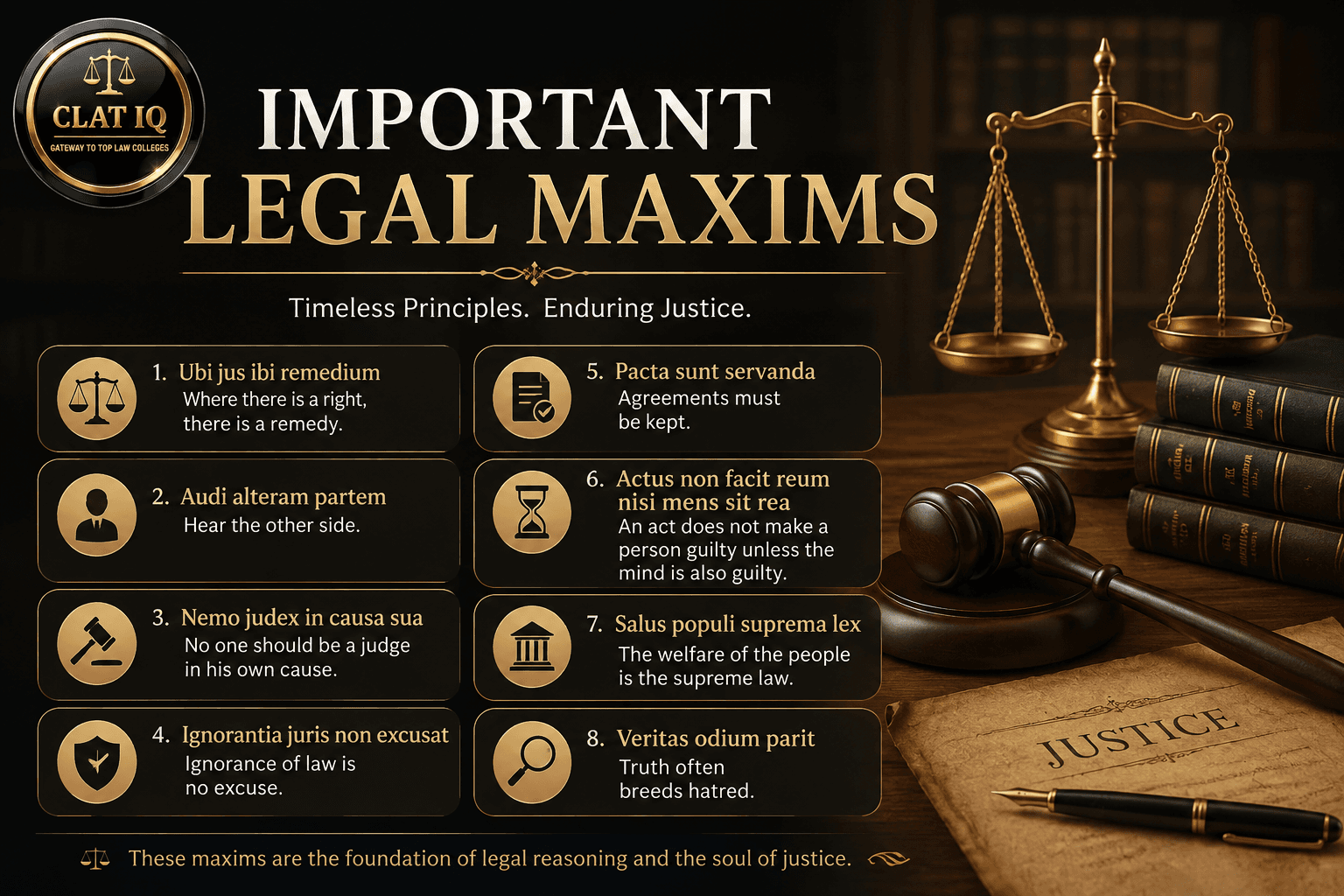
Important Legal Maxims for CLAT2027 written by expert team
If you’re preparing for CLAT and you don’t come from a law family, haven’t read a single bare act, and get slightly nervous every time…