Resource
Test Blog
8 min read
A Current Affairs Deep Dive for CLAT Aspirants
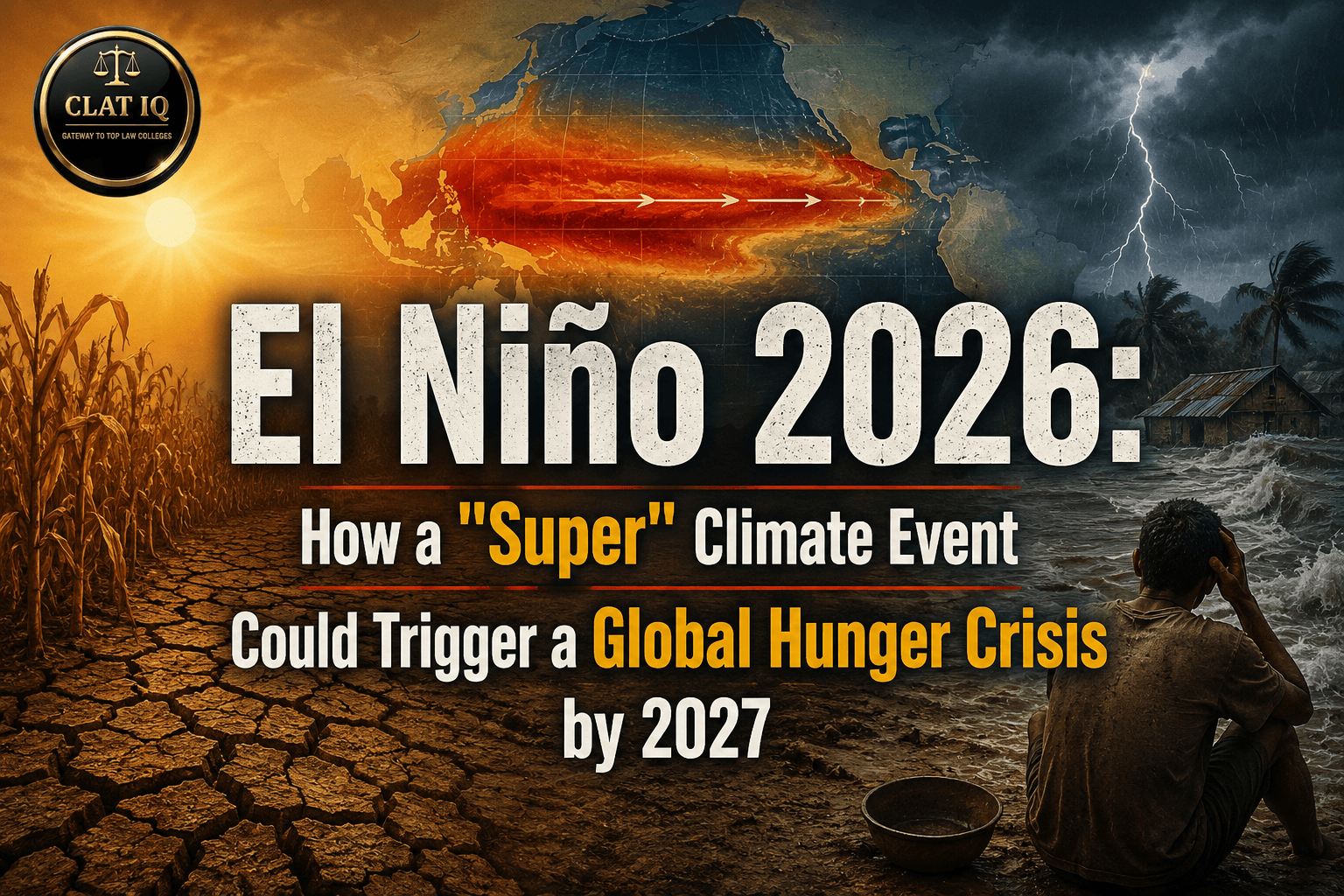
For CLAT aspirants, current affairs is not just about memorising headlines — it is about understanding how events connect to law, policy, and governance. Few phenomena illustrate this better than El Niño, a climate pattern most people associate with erratic rainfall and hot summers. But in 2026, meteorologists and economists are watching something bigger: forecasts of what could become one of the strongest El Niño events ever recorded, with the potential to disrupt global food production so severely that agencies are already warning of a hunger crisis stretching into 2027.
This topic sits at the intersection of environmental law, international trade law, human rights law (the right to food), and governance — all themes CLAT's General Knowledge and Current Affairs section, as well as the reasoning-based passages in the Legal Reasoning section, love to test. This blog breaks the issue down comprehensively: what El Niño is, why 2026 is different, how it threatens food security, and what legal and policy frameworks are relevant.
El Niño is the warm phase of the El Niño–Southern Oscillation (ENSO), a naturally occurring climate pattern involving fluctuations in ocean temperature in the central and eastern tropical Pacific Ocean. Under normal conditions, trade winds blow warm surface water westward toward Asia and Australia, allowing cooler water to rise (upwell) along the coast of South America. During El Niño, these trade winds weaken or reverse, causing warm water to pile up in the central and eastern Pacific instead.
This seemingly localised ocean phenomenon has global "teleconnections" — meaning it reshapes rainfall and temperature patterns across continents simultaneously. Typically:
Drought risk rises in Southeast Asia, India, Australia, Southern Africa, and parts of Central America.
Excess rainfall and flooding risk rises in parts of South America, East Africa, and the southern United States.
Global average temperatures rise, since the Pacific releases stored ocean heat into the atmosphere.
ENSO cycles between El Niño, La Niña (its cooling counterpart), and neutral phases roughly every two to seven years. The world's last major "Super El Niño" event was in 2015–16, and before that, 1997–98.
Through the middle of 2026, forecasting agencies have converged on an unusually alarming picture:
NOAA's Climate Prediction Center has confirmed El Niño conditions are already established and expected to strengthen through the rest of the year, with a very high probability — around 97% — of the event persisting into early spring 2027.
Multiple international model ensembles, including NOAA's experimental SPEAR system, have projected the event could reach "very strong" or historic intensity by autumn/winter 2026, with over 60–80% odds of crossing the "very strong" threshold.
Analysis of hundreds of model runs by climate researchers suggests sea surface temperatures in the key Niño 3.4 monitoring region could peak well above the previous record set during the 2015–16 event, with a majority of model runs projecting this could become the strongest El Niño in the modern instrumental record.
The World Meteorological Organization (WMO) has flagged an 80%+ probability of El Niño conditions dominating through mid-to-late 2026, with above-average global temperatures forecast almost everywhere.
In short: this is not a routine ENSO fluctuation. The scale and confidence of the forecasts — approaching near-certainty that El Niño will persist through the 2026 growing season and into early 2027 — is what has triggered concern among food security agencies, not just meteorologists.
To understand why an ocean phenomenon threatens dinner tables worldwide, aspirants should grasp the transmission chain:
Step 1 — Regional rainfall disruption. El Niño reliably shifts monsoon and rainfall patterns. India, for instance, faces a heightened risk of a below-average monsoon. Southeast Asian rice producers such as Thailand and Vietnam — the world's second and third largest rice exporters — face weakened rainfall that threatens planting and yields.
Step 2 — Yield losses concentrated in staple crops. Just four crops — wheat, rice, maize, and soybeans — account for over 60% of global caloric intake. Because El Niño's effects are correlated across multiple continents at once (a "teleconnection" effect), it can simultaneously depress yields in several major producing regions rather than affecting just one country. Analysts project rice output in badly affected regions could fall by a wide range — estimates run as high as 20 to 50 percent in the worst-hit areas — with South Asia, Southern Africa, and East Asia identified as most exposed.
Step 3 — Compounding regional effects. The impact is not uniform. Australia's wheat belt faces reduced planted area and lower output. Southern Africa and Central America typically see poor maize harvests due to drought. West Africa faces erratic rainfall threatening cocoa and other cash crops. Meanwhile, the Horn of Africa may actually see some rainfall relief after years of drought — showing why El Niño's impact must be assessed region-by-region rather than as a uniform global disaster.
Step 4 — Price transmission and market panic. Even a relatively small drop in global supply can translate into disproportionately large price spikes, because of speculative trading, panic buying, and — critically for CLAT aspirants studying trade law — government interventions such as export restrictions. When major exporters like India, Thailand, or Vietnam restrict rice exports to protect domestic supply (as has happened in past crises), it removes even more supply from the international market, worsening the very shortage everyone fears.
Step 5 — Compounding vulnerabilities. This El Niño is not unfolding in isolation. It arrives alongside elevated fertiliser and energy costs, ongoing geopolitical shocks affecting shipping and trade routes (such as disruptions near the Strait of Hormuz affecting fertiliser and energy flows), and regions already facing crisis-level food insecurity. In Myanmar, for example, over 12 million people were already facing crisis-level food insecurity (IPC Phase 3 or above) in mid-2026 even before the full effects of El Niño-driven weather disruption were felt, with projections that the number could climb significantly higher.
CLAT current affairs rewards nuance, not alarmism, so it's important to present both sides:
Reasons for serious concern:
The forecast strength and persistence of this El Niño is historically unusual, with near-certainty of conditions lasting through the entire 2026 growing season into 2027.
Multiple major producing regions (South/Southeast Asia, Australia, Southern Africa) face overlapping drought risk in the same window.
Vulnerable populations already facing food insecurity — from parts of Africa to Myanmar — have far less resilience to absorb further shocks.
Rising input costs (fertiliser, fuel, freight) compound the pure weather risk, discouraging farmers from planting even where rainfall might be adequate.
Reasons for cautious optimism:
Going into this event, global inventories of rice, wheat, maize, and soybeans were relatively high, offering a buffer compared to some past crises.
El Niño's effects are not globally uniform — losses in one region (e.g., Asian rice) are sometimes partially offset by gains elsewhere (e.g., soybean yields in the Americas tend to improve during El Niño).
Some major rice producers — including Cambodia, China, and Indonesia — entered 2026 with strong domestic reserves and production, and countries like Indonesia have allocated significant public funds toward food security measures.
Forecasting has improved substantially since the 1997–98 and 2015–16 events, giving governments more lead time to prepare, stockpile, and adjust trade policy.
The honest assessment: this is a serious, elevated risk — not a certainty — of a significant global food security shock. Agencies like the World Bank, IMF, and World Food Programme have already begun coordinated monitoring precisely because the risk is considered high enough to warrant a joint response mechanism.
This is where the topic becomes especially rich for CLAT preparation, since it connects climate science to law and governance:
The right to adequate food is recognised under Article 11 of the International Covenant on Economic, Social and Cultural Rights (ICESCR). A climate-driven hunger crisis raises questions about state obligations to ensure food security, and the extent to which climate change constitutes a human rights issue — a debate increasingly reflected in international climate litigation.
Under WTO rules, particularly the Agreement on Agriculture, countries retain some ability to impose export restrictions during food shortages, but such measures are controversial because they can worsen global shortages even while protecting domestic consumers. This tension between national food security and international trade obligations is a recurring CLAT-relevant theme.
India's National Food Security Act, 2013, guarantees subsidised foodgrains to a large section of the population. A weak monsoon driven by El Niño directly stress-tests this framework, along with the Essential Commodities Act, 1955, which empowers the government to regulate the production, supply, and distribution of essential goods — including imposing stock limits during shortages.
While El Niño itself is a natural phenomenon, scientists note that climate change may be intensifying its variability and extremes. This links the topic to India's and the world's obligations under the Paris Agreement, and to domestic environmental governance questions about drought preparedness, irrigation infrastructure, and climate adaptation policy.
Agencies like the Food and Agriculture Organization (FAO), World Food Programme (WFP), World Bank, and IMF play coordinating roles in monitoring and responding to food crises — issuing joint statements and dashboards to track unfolding risk. Understanding the mandate and functions of these organisations is a recurring static GK theme in CLAT.
ENSO = El Niño–Southern Oscillation; El Niño is its warm phase, La Niña its cool phase.
2026's El Niño has been forecast with very high confidence (around 97% probability of persisting into early 2027) to become one of the strongest on record, potentially surpassing the 2015–16 and 1982–83 events.
Four crops — wheat, rice, maize, soybeans — supply over 60% of global calories.
Regions most at risk of yield losses: South Asia, Southeast Asia, Southern Africa, Australia, Central America.
Regions that may benefit: parts of the Americas (soybean yields), Horn of Africa (rainfall relief after prolonged drought).
Relevant Indian legislation: National Food Security Act, 2013; Essential Commodities Act, 1955.
Relevant international frameworks: ICESCR (Article 11 — right to food), WTO Agreement on Agriculture, Paris Agreement.
Key institutions to know: FAO, WFP, World Bank, IMF, WMO, NOAA, IMD (India Meteorological Department).
El Niño 2026 is a textbook example of how a physical climate event can cascade into economic, legal, and humanitarian consequences — precisely the kind of interconnected, real-world issue CLAT increasingly tests through comprehension-based current affairs passages. For aspirants, the key takeaway is not just "El Niño causes drought," but the full causal chain: ocean warming → disrupted rainfall → concentrated crop losses → price spikes and export restrictions → strain on legal and institutional frameworks designed to guarantee food security. Understanding this chain — and the legal instruments meant to respond to it — will serve you well whether the question appears in GK, Legal Reasoning, or even an essay-style answer in an interview.
Stay tuned to official sources like the WMO, NOAA, FAO, and World Bank Food Security Updates over the coming months, since this situation is still actively developing and will likely remain a major current affairs theme through the 2026–27 admission cycle.
Disclaimer: Climate forecasts are probabilistic and subject to change as new data emerges. Aspirants should verify the latest figures closer to their exam date from official sources such as NOAA, WMO, and the World Bank's Food Security Update.