Resource
Test Blog
8 min read
If you are preparing for CLAT, you have probably already noticed that the General Knowledge and Current Affairs (GKCA) section rewards students who understand why an institution matters, not just its date of birth. Few topics illustrate this better than the G20. It sits at the intersection of international relations, economics, and Indian foreign policy — exactly the kind of multi-dimensional topic CLAT loves to test through passage-based questions.
This blog breaks down the G20 from scratch: what it is, how it evolved, how it works, India's landmark 2023 presidency, and the most recent developments through 2026 — all framed the way a CLAT aspirant needs to understand them.
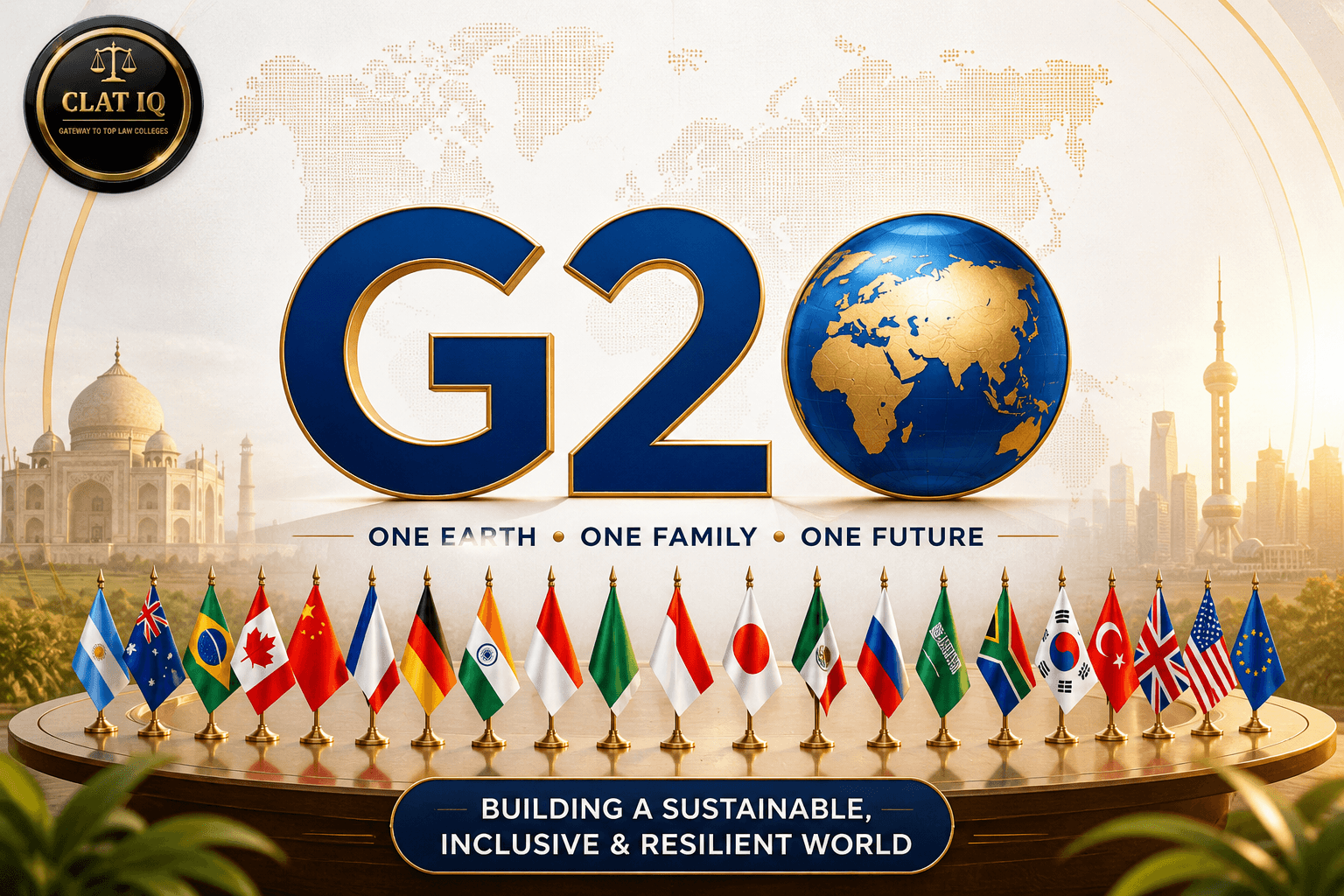
The G20, or Group of Twenty, is an intergovernmental forum comprising 19 countries, the European Union, and (since 2023) the African Union. It was created to bring together the world's major developed and developing economies to discuss issues of global economic stability, financial regulation, and — over time — a much broader agenda including trade, climate, health, and digital economy.
Unlike the United Nations, the G20 has no permanent secretariat, no formal charter, and no legally binding powers. It functions purely through consensus and diplomatic coordination. This is a crucial point for CLAT: examiners often test whether students confuse the G20 with a treaty-based organisation like the WTO or a UN body. It is neither. It is a forum — a annual rotating conversation among the world's largest economies, collectively representing around 85% of global GDP, over 75% of global trade, and about two-thirds of the world's population.
CLAT's GKCA passages frequently test institutional literacy — knowing what a body is meant to do, its legal character, and how decisions made there translate (or fail to translate) into binding law. The G20's non-binding nature is a recurring examination point, especially in comparison-based MCQs asking you to distinguish the G20 from the UN Security Council, WTO, or IMF.
To understand the G20, you need a short history lesson, because CLAT often frames GK questions historically.
1997–99: The Asian Financial Crisis exposed how interconnected the global economy had become, and how emerging economies like Indonesia, Thailand, and South Korea could destabilise markets far beyond their borders. The G7 (a club of the world's richest democracies — US, UK, Canada, France, Germany, Italy, Japan) realised that discussions on financial stability could no longer exclude large emerging economies.
1999: The G20 was formed, initially as a meeting of finance ministers and central bank governors, not heads of state. Its first meeting was held in Berlin.
2008: The Global Financial Crisis was the turning point. As markets crashed worldwide, world leaders recognised that finance ministers alone could not coordinate a response of this scale. The G20 was elevated to the level of Heads of State and Government, with the first leaders' summit held in Washington, D.C. in November 2008.
Since then, the G20 has met every year, expanding its scope well beyond finance to include trade, employment, energy, anti-corruption, health, digital economy, and climate change.
CLAT tip: Remember the sequence — 1997 Asian Financial Crisis → 1999 G20 formed (finance ministers level) → 2008 Global Financial Crisis → 2008 first Leaders' Summit in Washington. This causal chain is a favourite for both factual and reasoning-based questions.
The G20 consists of:
19 countries: Argentina, Australia, Brazil, Canada, China, France, Germany, India, Indonesia, Italy, Japan, Mexico, Russia, Saudi Arabia, South Africa, South Korea, Turkey, the United Kingdom, and the United States.
Plus two regional blocs:
The European Union, a founding-level participant since the G20's inception.
The African Union, admitted as a permanent member during India's presidency at the 2023 New Delhi Summit — a landmark moment for African representation in global economic governance and one of the signature achievements of India's G20 year.
This addition of the African Union is one of the most important recent facts for CLAT aspirants, because it demonstrates India's diplomatic emphasis on the "Global South" — a phrase you should be comfortable defining and contextualising, since it recurs across CLAT GK passages on foreign policy.
Beyond permanent membership, the host country each year invites additional "guest" nations and international organisations — bodies like the UN, WHO, WTO, IMF, World Bank, and regional development banks are regularly invited to G20 discussions, even though they are not members.
There is no G20 headquarters and no standing bureaucracy. Instead, the G20 operates through a rotating annual presidency. Each year, a different member country chairs the G20, hosts the leaders' summit, sets the agenda, and coordinates the many ministerial meetings and working groups that happen throughout the year.
The presidency rotates among the different regional groupings, and outgoing, current, and incoming presidencies work together informally as a "Troika" to ensure continuity of agenda from one year to the next.
Two broad tracks structure G20 work:
The Finance Track — led by finance ministers and central bank governors, focused on macroeconomic policy, financial regulation, taxation, and debt sustainability.
The Sherpa Track — led by each country's "Sherpa" (a senior official who prepares the ground for the leaders' summit), covering the broader agenda: trade, agriculture, health, employment, anti-corruption, energy, environment, tourism, culture, and digital economy.
At the end of each year's discussions, the host typically issues a Leaders' Declaration — a consensus statement summarising the group's shared priorities. Because the G20 is not a treaty body, this declaration is politically significant but not legally enforceable.
This is, without question, the most exam-relevant chapter of the G20 story for Indian law aspirants, so let's go deep.
India held the G20 presidency from 1 December 2022 to 30 November 2023, culminating in the 18th G20 Leaders' Summit, held on 9–10 September 2023 at Bharat Mandapam, Pragati Maidan, New Delhi.
Theme: "Vasudhaiva Kutumbakam" — a Sanskrit phrase from the Maha Upanishad meaning "One Earth, One Family, One Future." This phrase is a CLAT favourite; expect direct recall questions on its meaning and Sanskrit origin.
Logo: Combined the Indian tricolour with a globe atop a lotus, alongside "Bharat" written beneath "India" — itself a subject of public discussion at the time regarding India's global branding.
Venue: Bharat Mandapam, Pragati Maidan, New Delhi — India's newly built international convention centre, inaugurated ahead of the summit.
Chair: Prime Minister Narendra Modi.
Landmark outcome: The New Delhi Leaders' Declaration, adopted by consensus despite the geopolitical tensions surrounding the Russia-Ukraine conflict — widely reported as a major diplomatic achievement for India's presidency, since previous G20 meetings that year had struggled to agree on joint statements.
African Union's admission as a permanent G20 member, announced by PM Modi at the opening of the summit — a moment considered symbolically significant for India's positioning as a voice of the developing world.
India's presidency also emphasised inclusive growth, digital public infrastructure (showcasing India's UPI and Aadhaar-based systems), climate finance, women-led development, and reform of multilateral institutions such as the UN Security Council and international financial institutions like the IMF and World Bank.
A notable side outcome was the announcement of the India-Middle East-Europe Economic Corridor (IMEC), a proposed multi-modal transport and infrastructure corridor connecting India to Europe via the Gulf and Israel — frequently tested alongside G20 questions because of its geo-economic significance.
Why CLAT loves this topic: It combines constitutional/civic literacy (host cities, government initiatives) with international relations and current affairs — a genuinely interdisciplinary passage source. Expect questions testing the theme's translation, the venue's name, the declaration's title, and India's specific diplomatic contributions (African Union entry, IMEC, Digital Public Infrastructure).
CLAT aspirants must also track the sequence of presidencies immediately following India's, since "who hosted the G20 summit in [year]" is a classic single-line factual question.
2024 — Brazil, hosting the 19th G20 Summit in Rio de Janeiro, under President Luiz Inácio Lula da Silva, with the theme "Building a Just World and a Sustainable Planet."
2025 — South Africa, hosting the 20th G20 Summit in Johannesburg (22–23 November 2025) — <cite index="5-1">the first G20 summit ever held on the African continent</cite>, chaired by President Cyril Ramaphosa, under the theme "Solidarity, Equality, Sustainability." This summit focused heavily on issues important to developing economies: climate-related disaster risk, debt sustainability, and financing a just energy transition.
2026 — United States, hosting the 21st G20 Summit, scheduled for 14–15 December 2026 at a venue in the Miami, Florida area. This upcoming U.S. presidency has already drawn attention for departing from recent tradition: <cite index="4-1">reports indicate the U.S. plans to narrow the agenda</cite>, moving away from themes like climate change, debt, and sustainability that dominated the South African presidency, and instead prioritising energy security, deregulation, and technological innovation. There has also been diplomatic controversy: <cite index="2-1">the United States announced that South Africa will not be invited to the 2026 summit</cite>, a decision tied to disputes from the Johannesburg summit.
CLAT tip: Aspirants should always keep a running one-line note for the current and immediately preceding two or three G20 presidencies — host country, city, theme, and any single standout outcome. This is low-effort, high-yield revision because examiners frequently draw the most recent host and theme directly into passage-based or fact-based questions.
CLAT's current affairs section is not asked in isolation — it often connects to the legal reasoning and constitutional sections through passage-based comprehension. Here's how the G20 links to broader legal themes you should be comfortable discussing in an essay or passage context:
Global economic governance and sovereignty: The G20's consensus-based, non-binding structure raises interesting jurisprudential questions about how international soft law shapes domestic policy without formal treaty obligations — a useful conceptual bridge to international law modules.
India's foreign policy doctrine: The G20 presidency reflected India's stated foreign policy approach of "Vishwa Bandhu" (friend to the world) and its positioning as a bridge between the developed and developing world — themes that also surface in questions about India's UN Security Council reform advocacy.
Institutional comparison: Many CLAT passages ask students to compare the G20 with the G7, BRICS, WTO, and the UN — understanding the legal character (binding vs non-binding), membership basis, and founding purpose of each is essential.
Year Host Country City Theme/Notes 2008 United States Washington, D.C. First Leaders' Summit 2021 Italy Rome "People, Planet, and Prosperity" 2022 Indonesia Bali "Recover Together, Recover Stronger" 2023 India New Delhi "Vasudhaiva Kutumbakam"; AU admitted 2024 Brazil Rio de Janeiro "Building a Just World..." 2025 South Africa Johannesburg First summit in Africa 2026 United States Miami area Narrower agenda; South Africa excluded
Which Sanskrit phrase, meaning "One Earth, One Family, One Future," served as the theme of India's G20 presidency?
The African Union was admitted as a permanent member of the G20 during which country's presidency?
Arrange in chronological order: (a) First G20 Leaders' Summit (b) Formation of G20 at finance minister level (c) Asian Financial Crisis (d) New Delhi G20 Summit.
Which was the first G20 summit to be held on the African continent?
What is the "Sherpa Track" in the context of the G20?
(Answers: 1. Vasudhaiva Kutumbakam; 2. India, 2023; 3. c → b → a → d; 4. 2025 Johannesburg Summit; 5. The track led by senior officials called Sherpas that prepares the broader, non-finance agenda for the leaders' summit.)
The G20 is a textbook example of how CLAT's current affairs section tests layered understanding rather than rote memory. Knowing that India hosted the summit in 2023 is table stakes; knowing why the African Union's admission mattered, how the New Delhi Declaration was diplomatically significant, and how the G20's structure differs from binding international institutions is what separates a good answer from a great one.
Keep a running tracker of G20 presidencies as you move through the exam year — hosts, themes, and headline outcomes change annually, and CLAT's current affairs questions reward exactly that kind of updated, structured knowledge.