Resource
Test Blog
8 min read
Every year, lakhs of Class 12 students and graduates dream of walking into the campus of a National Law University (NLU). The gateway to almost all of these institutions is the Common Law Admission Test (CLAT) — one of India's most competitive entrance exams. But clearing CLAT is only half the battle. The bigger challenge often comes during counselling, when candidates must decide which NLUs to prioritize in their preference list.
This guide breaks down the top NLUs ranking, based on NIRF standings, CLAT closing ranks, placements, and overall reputation, to help you make an informed choice.
India currently has 28 National Law Universities. Of these, 27 admit students through CLAT, while NLU Delhi is the exception — it conducts its own entrance exam, AILET. With so many institutions offering a similar five-year integrated BA LLB structure, rankings become the primary tool for differentiating between them.
Rankings matter because they reflect:
Faculty quality and research output – how much original scholarship and teaching excellence an institution produces
Placement strength – the kind of law firms, judiciary positions, and corporate roles graduates land
Infrastructure – libraries, moot court facilities, hostels, and legal databases
Peer group and alumni network – the quality of your batchmates and seniors, which shapes internships and career opportunities
Historical reputation – how recruiters and the legal fraternity perceive a degree from that university
The most widely referenced ranking source is the National Institutional Ranking Framework (NIRF), released by the Ministry of Education. It evaluates law schools on five parameters: Teaching, Learning & Resources; Research and Professional Practice; Graduation Outcomes; Outreach and Inclusivity; and Perception.
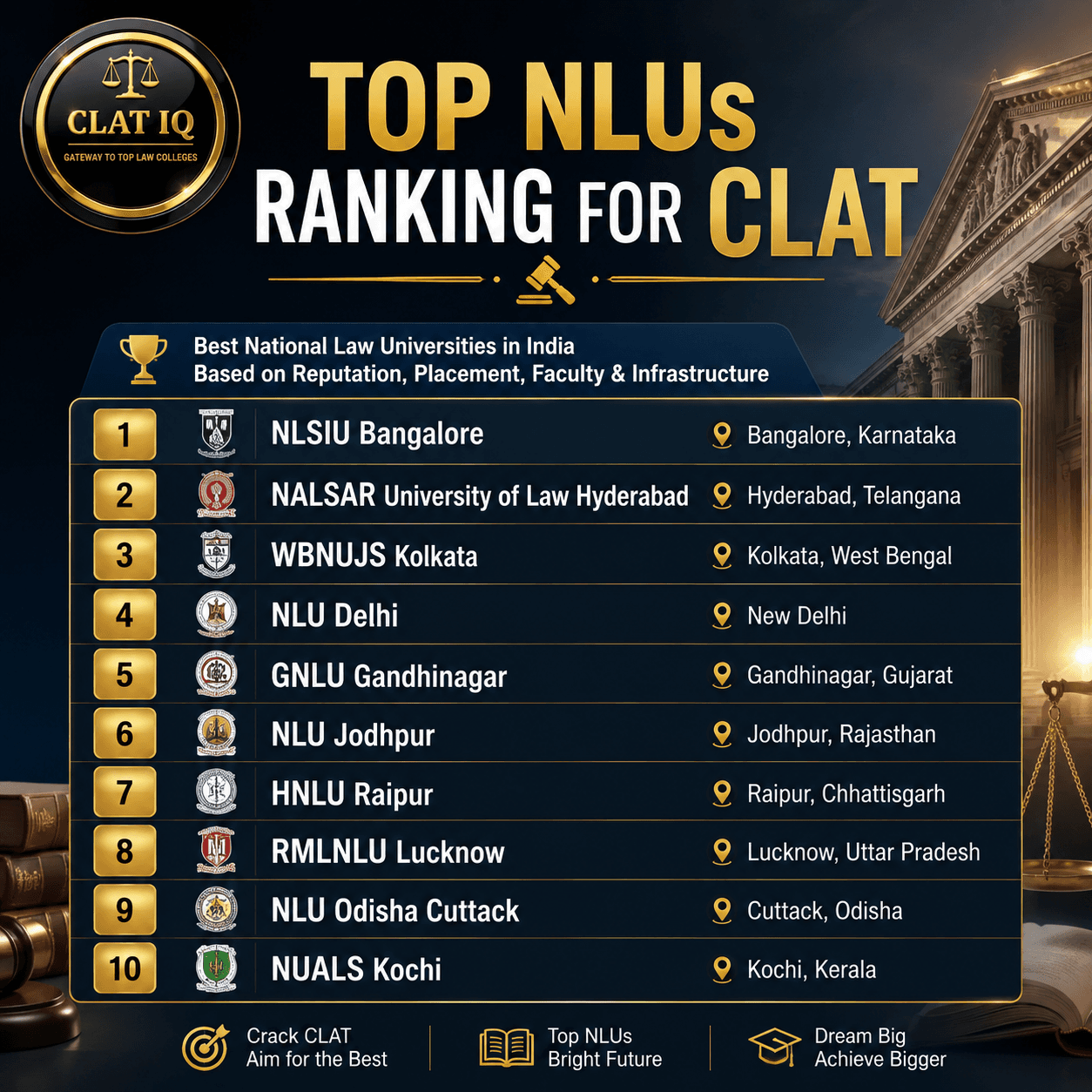
Here is how the top NLUs currently stack up, combining NIRF standing with CLAT counselling performance:
NLSIU has held the number one position in NIRF law rankings consistently since 2022, and it remains the most sought-after NLU in CLAT counselling. Established in 1986, it was the first NLU in India and is often called the "Harvard of India" in legal circles. Its closing rank in CLAT counselling typically stays around the top 100–120 for the general category, making it the toughest NLU to get into. NLSIU is particularly known for its work in constitutional law, policy research, and its Master's in Public Policy program.
NLU Delhi consistently ranks second nationally, though it does not use CLAT for admissions — candidates must clear AILET instead. It's included here because most CLAT aspirants track its position as a benchmark, and many students appear for both exams. NLU Delhi's compact campus, strong faculty, and proximity to the Supreme Court, ministries, and top law firms give it exceptional exposure to litigation and policy work.
NALSAR has remained firmly in the top three for years and is frequently seen as the strongest CLAT-admitted alternative to NLSIU. Its closing rank generally falls between 150–170 for the general category. NALSAR is particularly reputed for its intellectual property law and technology law programs, and it draws some of the best corporate law firm recruiters in the country.
Also known as NUJS, this university has stayed in the top five NIRF rankings and is a strong CLAT choice, with closing ranks typically in the 280–330 range. WBNUJS is well known for human rights law and corporate law specializations, and it often reports some of the highest average placement packages among NLUs.
GNLU has shown consistent upward movement in rankings and entered the national top five in recent NIRF cycles. It offers one of the most diverse sets of undergraduate programs among NLUs, including BA LLB, BBA LLB, BCom LLB, BSc LLB, and BSW LLB. Its closing rank typically hovers between 420–480.
Beyond the top five, several NLUs continue to be reliable, high-quality choices for CLAT aspirants:
National Law University, Jodhpur (NLUJ) – Known for its strong industry-integration approach and closing ranks generally in the 350–400 range.
National Law Institute University (NLIU), Bhopal – A historically well-regarded NLU with central-India connectivity and strong government sector placements.
Dr. Ram Manohar Lohiya National Law University (RMLNLU), Lucknow – Popular for its focus on judiciary preparation and public sector careers.
Hidayatullah National Law University (HNLU), Raipur – Has seen notable infrastructure improvements in recent years.
Rajiv Gandhi National University of Law (RGNUL), Patiala – Known for energy and environmental law specializations.
National University of Advanced Legal Studies (NUALS), Kochi – Popular for maritime law given its coastal location.
National Law University Odisha (NLUO), Cuttack – Has shown consistent improvement in NIRF rankings.
Chanakya National Law University (CNLU), Patna – Has also climbed several ranks in recent NIRF cycles.
Because CLAT counselling involves ranking 27 universities, most coaching institutes and aspirants informally group NLUs into three tiers based on NIRF performance and historical CLAT closing ranks.
Tier 1 typically includes NLSIU Bangalore, NALSAR Hyderabad, WBNUJS Kolkata, NLU Jodhpur, and GNLU Gandhinagar. Admission generally requires a CLAT rank within the top 500.
Tier 2 includes well-established universities such as NLIU Bhopal, RMLNLU Lucknow, HNLU Raipur, RGNUL Patiala, NUALS Kochi, NLUO Cuttack, CNLU Patna, NUSRL Ranchi, MNLU Mumbai, and DSNLU Visakhapatnam. These are generally accessible to candidates ranking between 500 and 2,000.
Tier 3 consists mostly of newer NLUs still building their alumni networks, infrastructure, and placement records — including HPNLU Shimla, DNLU Jabalpur, NLUT Agartala, DBRANLU Sonipat, RPNLU Prayagraj, MNLU Nagpur, MNLU Aurangabad, GNLU Silvassa, and IIULER Goa.
It's worth noting that tier classification isn't a permanent label — several Tier 3 institutions have shown consistent improvement in recent NIRF cycles and are steadily climbing toward Tier 2 status as their faculty, infrastructure, and alumni networks mature.
The competition for NLU seats remains intense. Roughly 60,000 or more candidates typically appear for CLAT each year, competing for around 2,700 undergraduate seats spread across the 27 CLAT-participating NLUs. NLSIU Bangalore, being the oldest and largest, offers around 310 undergraduate seats, while some of the newer NLUs like IIULER Goa and RPNLU Prayagraj offer as few as 60.
This means that beyond the "top five" everyone talks about, there are genuinely strong options across all three tiers — the right choice often depends as much on your specific CLAT rank as on rankings alone.
Placement outcomes heavily influence where an NLU sits in popular perception, even when they diverge slightly from NIRF's official methodology. Top recruiters across NLUs include major law firms such as Cyril Amarchand Mangaldas, Shardul Amarchand Mangaldas, AZB & Partners, Trilegal, and Khaitan & Co, along with corporate legal departments, PSUs, and international organizations.
Institutions like WBNUJS Kolkata and NLSIU Bangalore are frequently cited for having some of the highest average placement packages among NLUs, while NLU Delhi and NALSAR Hyderabad are equally strong performers. Beyond corporate law, NLU graduates increasingly move into judicial services, civil services, policy research think tanks, and academia — so "best placements" can mean different things depending on your career goal.
While rankings offer a useful starting point, they shouldn't be the only factor guiding your NLU preference list. Consider the following as well:
Career goals: If corporate law is your target, prioritizing NLSIU, NALSAR, WBNUJS, GNLU, and NLU Jodhpur makes sense. If you're inclined toward judiciary or civil services, universities like RMLNLU Lucknow or CNLU Patna, which have strong track records in these areas, may be worth prioritizing even if their NIRF rank is lower.
Location advantages: NLUs situated in major metros — Mumbai, Delhi, Bangalore, Kolkata — often provide better internship access to top law firms simply due to proximity.
Specializations: Some NLUs have built strong niches — maritime law at NUALS Kochi, energy law at RGNUL Patiala, environmental law at HPNLU Shimla, and technology law at NALSAR.
Financial considerations: Annual tuition fees vary significantly, from around ₹80,000–1,20,000 at some of the newer or state-subsidized NLUs to over ₹2,00,000 at NLSIU Bangalore. Total five-year costs can range widely, so factor this into your decision alongside potential scholarships.
Campus culture and peer group: Wherever possible, talk to current students or alumni. A university's academic culture, faculty accessibility, and moot court culture can matter as much as its ranking.
A common mistake CLAT aspirants make is filling only a handful of NLU preferences, hoping for a Tier 1 seat and missing out on a Tier 2 or Tier 3 option they might actually have qualified for. The general strategic advice is:
List all 27 CLAT-participating NLUs in your preference order, even if some are far down the list. This maximizes your chances of getting a seat somewhere rather than losing eligibility altogether.
Rank by realistic expectation, not just aspiration — cross-check your CLAT rank against historical closing ranks for each NLU.
Balance ranking with fit — a Tier 2 NLU with strong placements in your area of interest may serve you better than a Tier 1 NLU where you'd be at the bottom of the merit list.
Watch the counselling window closely — CLAT counselling typically opens in mid-to-late December and closes within about ten days, so preference lists need to be finalized without last-minute rushing.
The NLU ranking landscape has remained fairly stable at the very top — NLSIU Bangalore, NLU Delhi, NALSAR Hyderabad, WBNUJS Kolkata, and GNLU Gandhinagar have consistently occupied the top positions for several years. But the real story for most CLAT aspirants lies in the tiers below: Tier 2 and Tier 3 NLUs are steadily closing the gap through improved infrastructure, growing alumni networks, and rising NIRF scores.
Ultimately, no ranking list can substitute for self-assessment. Your CLAT rank, career aspirations, financial situation, and personal comfort with a particular city should all factor into your final decision. A well-researched preference list — built on both rankings and realistic expectations — will serve you far better during counselling than chasing prestige alone.
Whichever NLU you land in, remember that the "NLU tag" itself carries significant weight in the Indian legal job market. What you make of your five years there — through internships, moot courts, research, and networking — will ultimately shape your career far more than the rank on a table.
Rankings and closing ranks mentioned in this article are based on recent NIRF cycles and CLAT counselling trends, and are subject to change with each admission cycle. Aspirants are advised to verify the latest official notifications from the CLAT Consortium and NIRF before finalizing their preference lists.