

Resource
CLAT 2028 Strategy for Droppers
CLAT 2027 Strategy for dropper written by Lucknow's Best CLAT faculty CLAT IQ
4 min read
The bigger challenge often comes during counselling, when candidates must decide which NLUs to prioritize in their preference list.
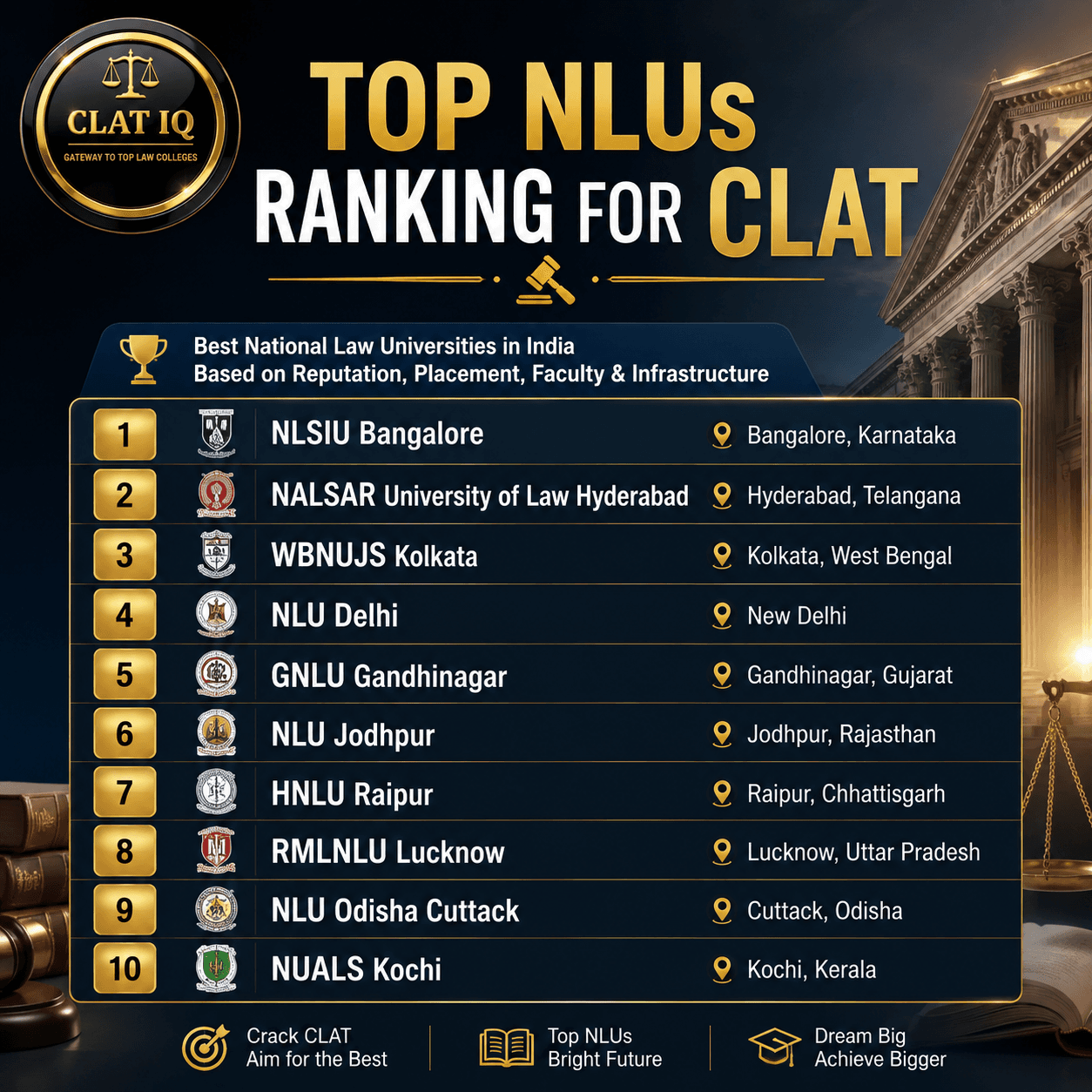
This guide breaks down the top NLUs ranking, based on NIRF standings, CLAT closing ranks, placements, and overall reputation, to help you make an informed choice.
India currently has 28 National Law Universities. Of these, 27 admit students through CLAT, while NLU Delhi is the exception — it conducts its own entrance exam, AILET. With so many institutions offering a similar five-year integrated BA LLB structure, rankings become the primary tool for differentiating between them.
Rankings matter because they reflect:
Faculty quality and research output – how much original scholarship and teaching excellence an institution produces
Placement strength – the kind of law firms, judiciary positions, and corporate roles graduates land
Infrastructure – libraries, moot court facilities, hostels, and legal databases
Peer group and alumni network – the quality of your batchmates and seniors, which shapes internships and career opportunities
Historical reputation – how recruiters and the legal fraternity perceive a degree from that university
The most widely referenced ranking source is the National Institutional Ranking Framework (NIRF), released by the Ministry of Education. It evaluates law schools on five parameters: Teaching, Learning & Resources; Research and Professional Practice; Graduation Outcomes; Outreach and Inclusivity; and Perception.
Here is how the top NLUs currently stack up, combining NIRF standing with CLAT counselling performance:
Aspect | Details |
|---|---|
Institute | National Law School of India University (NLSIU), Bangalore |
NIRF Ranking | Held the number one position consistently since 2022 |
CLAT Counselling Status | Most sought-after NLU in CLAT counselling |
Established | 1986 — the first NLU in India |
Reputation | Often called the "Harvard of India" in legal circles |
Closing Rank (General Category) | Approximately top 100–120 — toughest NLU to get into |
Areas of Special Reputation | Constitutional Law, Policy Research, Master's in Public Policy program |
Aspect | Details |
|---|---|
Institute | National Law University (NLU), Delhi |
National Ranking | Consistently ranks second nationally |
Admission Exam | Does not use CLAT — candidates must clear AILET instead |
Relevance to CLAT Aspirants | Tracked as a benchmark by most CLAT aspirants; many students appear for both exams |
Campus | Compact campus with strong faculty |
Location Advantage | Proximity to the Supreme Court, ministries, and top law firms |
Key Strength | Exceptional exposure to litigation and policy work |
Future judges if you want to became a best lawyer you can go with NLUD it provide broader future options
Aspect | Details |
|---|---|
Institute | NALSAR (National Academy of Legal Studies and Research) |
Overall Ranking | Firmly in the top three among NLUs for years |
Reputation | Frequently seen as the strongest CLAT-admitted alternative to NLSIU |
Closing Rank (General Category) | Approximately 150–170 |
Areas of Special Reputation | Intellectual Property (IP) Law, Technology Law |
Placement Strength | Draws some of the best corporate law firm recruiters in the country |
NALSAR has remained firmly in the top three for years and is frequently seen as the TOP NLU for bright future
Also known as NUJS, this university has stayed in the top five NIRF rankings and is a strong CLAT choice, with closing ranks typically in the 280–330 range. WBNUJS is well known for human rights law and corporate law specializations, and it often reports some of the highest average placement packages among NLUs.
GNLU has shown consistent upward movement in rankings and entered the national top five in recent NIRF cycles. It offers one of the most diverse sets of undergraduate programs among NLUs, including BA LLB, BBA LLB, BCom LLB, BSc LLB, and BSW LLB. Its closing rank typically hovers between 420–480.
Aspect | Details |
|---|---|
Institute | NALSAR (National Academy of Legal Studies and Research) |
Overall Ranking | Firmly in the top three among NLUs for years |
Reputation | Frequently seen as the strongest CLAT-admitted alternative to NLSIU |
Closing Rank (General Category) | Approximately 150–170 |
Areas of Special Reputation | Intellectual Property (IP) Law, Technology Law |
Placement Strength | Draws some of the best corporate law firm recruiters in the country |
Factor | Details |
|---|---|
Career Goals — Corporate Law | Prioritize NLSIU, NALSAR, WBNUJS, GNLU, and NLU Jodhpur |
Career Goals — Judiciary/Civil Services | Consider RMLNLU Lucknow or CNLU Patna, which have strong track records despite lower NIRF rank |
Location Advantages | NLUs in metros (Mumbai, Delhi, Bangalore, Kolkata) offer better internship access to top law firms due to proximity |
Specialization — Maritime Law | NUALS Kochi |
Specialization — Energy Law | RGNUL Patiala |
Specialization — Environmental Law | HPNLU Shimla |
Specialization — Technology Law | NALSAR |
Financial Considerations | Annual tuition ranges from ₹80,000–1,20,000 (newer/state-subsidized NLUs) to over ₹2,00,000 (NLSIU Bangalore); factor in total 5-year cost and scholarships |
Campus Culture & Peer Group | Talk to current students/alumni; academic culture, faculty accessibility, and moot court culture matter as much as ranking |
Tip: Use rankings as a starting point, but weigh them against your career goals, budget, and campus fit before finalizing your preference list.
While rankings offer a useful starting point, they shouldn't be the only factor guiding your
A common mistake CLAT aspirants make is filling only a handful of NLU preferences, hoping for a Tier 1 seat and missing out on a Tier 2 or Tier 3 option they might actually have qualified for. The general strategic advice is:
List all 27 CLAT-participating NLUs in your preference order, even if some are far down the list. This maximizes your chances of getting a seat somewhere rather than losing eligibility altogether.
Rank by realistic expectation, not just aspiration — cross-check your CLAT rank against historical closing ranks for each NLU.
Balance ranking with fit — a Tier 2 NLU with strong placements in your area of interest may serve you better than a Tier 1 NLU where you'd be at the bottom of the merit list.
Watch the counselling window closely — CLAT counselling typically opens in mid-to-late December and closes within about ten days, so preference lists need to be finalized without last-minute rushing.
so track every year NIRF ranking ,placment,campus culture and all wisely
Rankings and closing ranks mentioned in this article are based on recent NIRF cycles and CLAT counselling trends, and are subject to change with each admission cycle. Aspirants are advised to verify the latest official notifications from the CLAT Consortium and NIRF before finalizing their preference lists.
CLAT 2027 Strategy for dropper written by Lucknow's Best CLAT faculty CLAT IQ

CLAT Syllabus 2027/2028: Latest & Detailed Section-Wise Breakdown

CLAT 2028 Batch for Droppers: Why CLAT IQ Is the Right Choice