
CLAT 2026 · Complete Preparation Blueprint
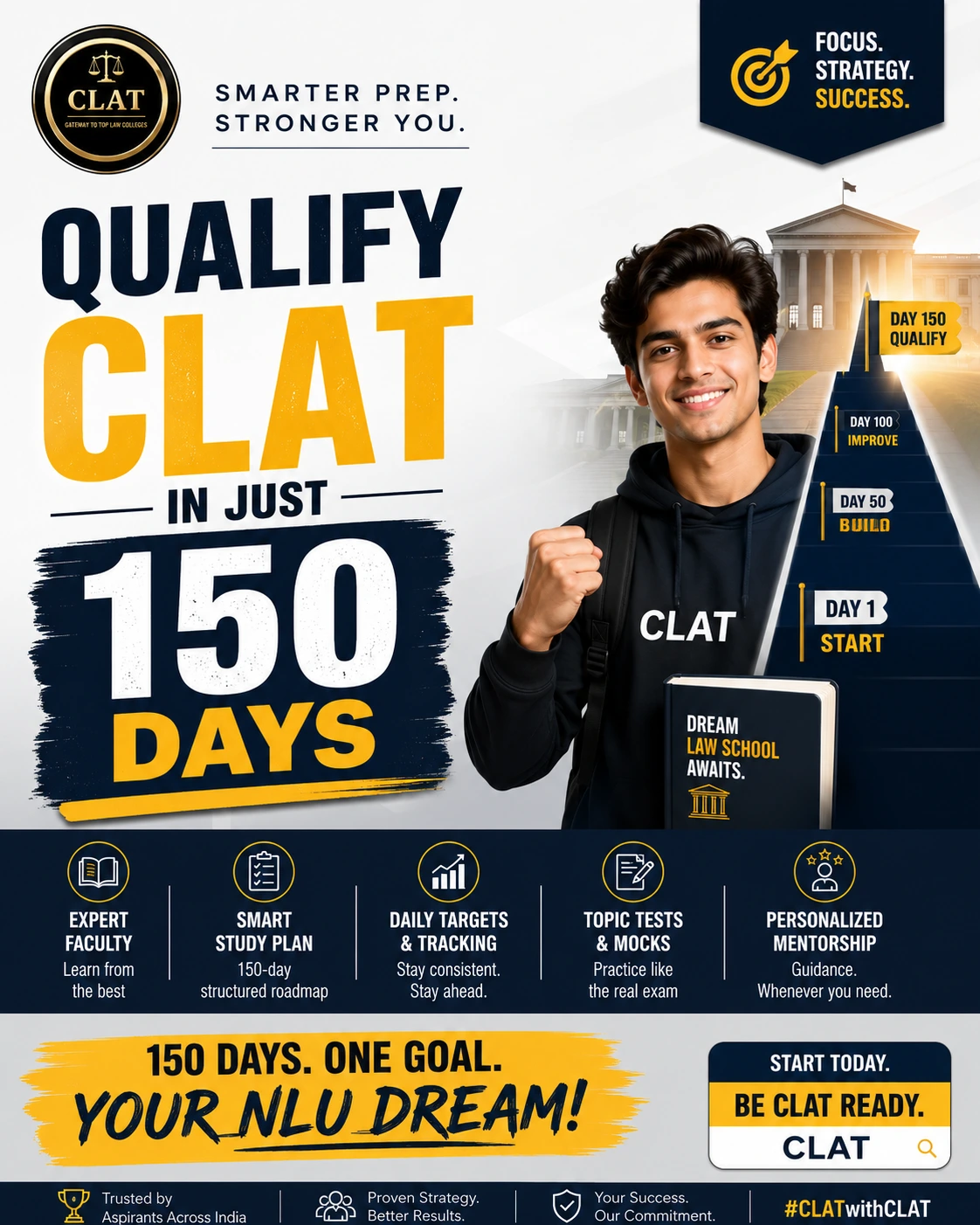
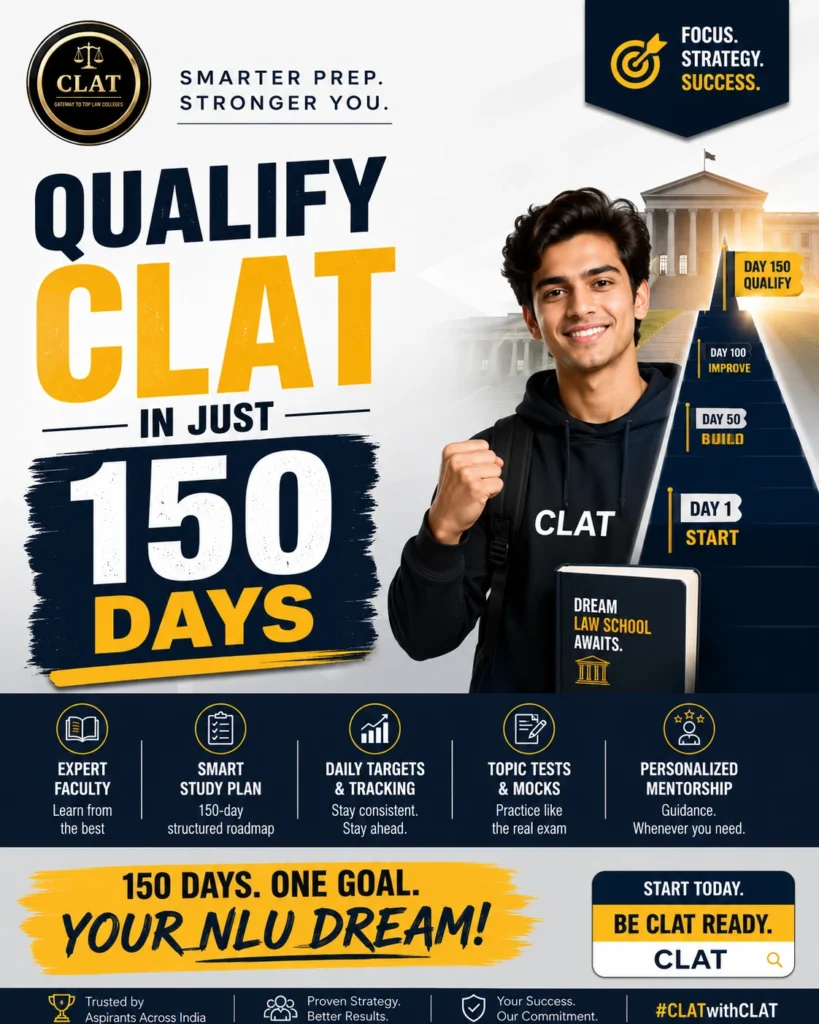
CLAT 2026 in 150 Days
एक सपना। एक रणनीति।
150 Days. One Dream. One Strategy. — Your week-by-week roadmap to crack CLAT 2026 and secure a seat in India’s top NLUs.
150Days Total
5Phases
5Subjects
120MCQs/Exam
150 दिन कम नहीं होते — अगर हर दिन सही दिशा में लगाया जाए।
CLAT (Common Law Admission Test) भारत के 24 National Law Universities में प्रवेश का एकमात्र रास्ता है। NLSIU Bangalore, NLU Delhi, NALSAR Hyderabad जैसे संस्थानों में सीट पाने का अर्थ है — एक शानदार कानूनी करियर की नींव।
यह blog उन students के लिए है जिनके पास अभी 150 दिन बचे हैं और वे जानना चाहते हैं: कहाँ से शुरू करूँ? कितना पढ़ूँ? कौन-सी books? कितने mock tests?
नीचे दी गई रणनीति systematically आपको हर subject में cover करेगी — English Language, Current Affairs & GK, Legal Reasoning, Logical Reasoning, और Quantitative Techniques।
Step 0 — Know the Battlefield
CLAT 2026 Exam Pattern
Before you prepare, know exactly what you’re preparing for. CLAT is a 120-question, 120-minute comprehension-based exam.
| Subject | Questions | Marks | Difficulty | Priority |
|---|---|---|---|---|
| English Language | 28–32 | 28–32 | Moderate | High |
| Current Affairs & GK | 35–39 | 35–39 | Dynamic | Very High |
| Legal Reasoning | 28–32 | 28–32 | Hard | Very High |
| Logical Reasoning | 22–26 | 22–26 | Moderate | Medium |
| Quantitative Techniques | 10–14 | 10–14 | Easy–Mod | Medium |
| TOTAL | 120 | 120 | — | — |
⚠️ Negative marking: −0.25 per wrong answer. Time management is critical.
The Master Plan
150-Day Phase-Wise Roadmap
Divide your 150 days into 5 distinct phases. Each phase has a clear goal — so you never feel lost.
Phase 1Foundation BuildingDay 1–30
यह phase आपकी नींव है। यहाँ हर subject की basics clear करनी हैं। कोई shortcut नहीं — सिर्फ समझ।
- English: Grammar rules, idioms, reading comprehension basics
- Legal Reasoning: Understand what Principle-Fact questions mean; read bare acts (IPC, CrPC overview)
- GK: Start a daily newspaper habit — The Hindu / Indian Express
- Logical Reasoning: Learn all reasoning types (syllogism, blood relations, coding-decoding)
- Quant: Brush up Class 10 Maths — percentages, ratios, averages, profit-loss
- Take 1 diagnostic mock test at end of Phase 1 to benchmark yourself
Phase 2Deep Concept MasteryDay 31–70
Foundation के ऊपर गहराई बनाइए। हर subject का harder portion यहाँ cover होगा।
- Legal Reasoning: Constitutional Law basics, Torts, Contracts, Criminal Law principles
- English: Inference-based RC, author’s tone, para-jumbles, critical reasoning
- GK: Maintain a monthly current affairs compilation; start legal GK (important judgments)
- Logical Reasoning: Practice 30 questions daily — analytical reasoning sets
- Quant: Data Interpretation, Simple/Compound Interest, Time-Speed-Distance
- Weekly sectional tests — one per subject every week
Phase 3Intensive PracticeDay 71–100
इस phase में speed और accuracy दोनों साथ आनी चाहिए। Timed practice शुरू होगी।
- 2 full-length mock tests per week (timed — exactly 120 minutes)
- Analyse every mock: subject-wise score, wrong answers, time per section
- Legal Reasoning: Solve 3 passage sets daily from previous year papers
- GK: Revise last 6 months current affairs; make short notes
- English: Target 85%+ accuracy in RC passages
- Identify your 2 weakest subjects — give them extra 30 min/day
Phase 4Mock Test MarathonDay 101–135
यह phase real exam जैसा है। हर दिन या alternate days full mock दीजिए।
- 3–4 full mock tests per week at exam-like conditions
- Maintain an error log — note why each wrong answer was wrong
- Revise static GK: Constitution, polity, Indian history, awards, summits
- Legal Reasoning: Cover previous 5 years CLAT papers completely
- Quant: Target 90%+ accuracy (only 10–14 questions — don’t lose easy marks)
- Weekly rank analysis if using a test series
Phase 5Revision & Final PolishDay 136–150
नई चीज़ें मत पढ़ो। जो पढ़ा है उसे strong करो। Confidence बनाओ।
- Revise all your short notes and error logs
- 1–2 mock tests only (don’t overload yourself)
- GK: Last-minute current affairs compilation (last 3 months)
- Re-read important legal principles — Constitution Articles, landmark cases
- Day 148–150: Rest, light revision, mental preparation
- Exam day strategy: attempt order, time allocation, guess policy

Daily Discipline
Ideal Daily Schedule (7–8 Hours)
Consistency beats intensity. 7 focused hours daily for 150 days = 1,050 hours of preparation — more than enough to crack CLAT.
📅 Sample Day Schedule
6:00 – 7:00Newspaper Reading — The Hindu/IE; note important CA events
7:00 – 9:00Subject Study Block 1 — Legal Reasoning (concept + 2 passage sets)
9:00 – 9:30Break + Breakfast
9:30 – 11:30Subject Study Block 2 — English Language (RC + Vocab)
11:30 – 12:30GK Revision — Monthly CA notes / Static GK
12:30 – 2:00Lunch + Rest
2:00 – 3:30Logical Reasoning — 30 questions timed practice
3:30 – 4:30Quantitative Techniques — 15 questions + DI sets
4:30 – 5:00Break + Walk
5:00 – 7:00Mock Test / Sectional Test (alternate days full mock)
7:00 – 8:00Error Log + Revision — Review mistakes, update notes
8:00 – 9:00Dinner + Light reading (legal news / judgments)
Subject-Wise Strategy
CLAT 2026 UG Syllabus

Consortium of NLUshttps://consortiumofnlus.ac.in › clat-http://CLAT 2026 UG Syllabus Consortium of NLUs https://consortiumofnlus.ac.in › clat-
How to Conquer Each Section
⚖️ Legal Reasoning
Best CLAT Coaching in Lucknow for CLAT 2027 & 2028
Highest Weightage
⚖️
CLAT का सबसे important section। Passage-based questions में principle apply करनी होती है। Law background जरूरी नहीं।
- Always read the given principle carefully — don’t apply outside knowledge
- Practice with real CLAT past papers (2015–2024)
- Learn: Torts, Contract, Constitutional principles, Criminal Law basics
- Target: 85%+ accuracy in this section
- 50+ passage sets practice before exam
📰 Current Affairs & GK
Dynamic Section
📰
सबसे अधिक questions इसी section से। Daily newspaper + monthly compilation = success.
- Read The Hindu daily — 45 minutes minimum
- Monthly CA magazines: Clat Possible, Legal Edge
- Static GK: Indian Polity, Constitution, History, Geography
- Important judgments of last 1 year must be memorized
- International events, appointments, awards, summits
📖 English Language
Scoring
📖1 CLAT Preparation Without Coaching
Comprehension, vocabulary, grammar — all passage-based. Build reading speed first.
- Read 1 editorial daily — analyse argument structure
- Vocabulary: 15 new words per day with context
- Practice RC from diverse topics: law, economy, science, literature
- Avoid reading word-by-word — skim for main idea first
- Target 90 seconds per question in English section
🧩 Logical Reasoning
Moderate
🧩
Critical reasoning, assumption-conclusion, argument analysis — CLAT tests your legal thinking here.
- Critical reasoning is more important than pure puzzles in CLAT
- Practice: Weaken/Strengthen argument questions daily
- Avoid overthinking — go with the most direct answer
- 30 questions daily for Phases 2 & 3
- Use R.S. Aggarwal for basics, then move to CLAT-specific material
🔢 Quantitative Techniques
Easy Marks
🔢
Only 10–14 questions but all passage-based graphs/data. Don’t ignore — score 10/10 here easily.
- Focus: Data Interpretation, Ratios, Percentages, Averages
- Questions come from graphs, charts, tables — not algebra
- 30 minutes/day is enough — no need to over-invest
- Practice DI sets from CLAT previous years
- Mental math speed: practice calculation without calculator
Resource List
Best Books & Resources for CLAT 2026
Legal Reasoning
AP Bhardwaj — Legal Reasoning for CLAT
Must Read ★★★★★
English Language
Wren & Martin (Grammar) + Word Power Made Easy (Vocab)
Essential ★★★★★
Logical Reasoning
R.S. Aggarwal + MK Pandey (Analytical Reasoning)
Recommended ★★★★
GK & Current Affairs
Lucent’s GK + The Hindu + CLATGyan Monthly
Daily Use ★★★★★
Quantitative Techniques
NCERT Class 10 Maths + CLAT-specific DI sets
Sufficient ★★★★
Previous Year Papers
CLAT 2015–2024 Solved Papers (Universal / LexisNexis)
Non-Negotiable ★★★★★
💡 Online Resources: CLATGyan, LegalEdge, Clat Possible, PW Law (free videos on YouTube)
Self-Assessment
Weekly Progress Tracker
Use this framework every week to measure your progress honestly.
Target Accuracy by Week 20 (Exam Week)
Legal Reasoning
85%
Current Affairs
80%
English Language
88%
Logical Reasoning
78%
Quantitative Tech.
90%
Critical Advice
Do’s & Don’ts of CLAT Preparation
✅ DO These Always
- Read newspaper daily without fail
- Maintain an error log after every mock
- Revise weekly — don’t just move forward
- Solve CLAT past papers (2015–2024)
- Attempt full mocks in exam-like environment
- Sleep 7–8 hours — brain consolidates during sleep
- Make short notes for last-minute revision
- Track your weak areas every week
❌ AVOID These Mistakes
- Don’t skip Current Affairs even for 1 day
- Don’t memorise law — understand and apply
- Don’t attempt new topics in last 15 days
- Don’t take 10+ mocks without analysing them
- Don’t neglect English — it’s 28+ questions
- Don’t use outside legal knowledge in Legal Reasoning
- Don’t panic if one mock score is low
- Don’t guess randomly — −0.25 is real
Practice Questions
Sample CLAT-Style Questions
⚖️ Legal Reasoning
Q1. Principle: A person is liable for negligence if they fail to take reasonable care that a reasonable person would take in similar circumstances.
Facts: Ramesh, a doctor, prescribed medicine without examining the patient. The patient suffered side effects. A qualified doctor would always examine before prescribing.
Which of the following is correct?
- A) Ramesh is not liable as he is a qualified doctor
- B) Ramesh is liable for negligence as he failed to act as a reasonable doctor would
- C) Ramesh is liable only if the patient dies
- D) Ramesh is not liable as prescribing is a medical judgment
✅ Answer: B — The principle requires “reasonable care.” A reasonable doctor examines before prescribing. Ramesh failed this standard, hence liable.
Q2. Principle: An agreement made under coercion is voidable at the option of the party whose consent was so caused.
Facts: Seema signed a property transfer deed after her landlord threatened to evict her illegally. She later challenged the agreement in court.
- A) The agreement is void ab initio
- B) The agreement is valid as she signed it
- C) The agreement is voidable and Seema can challenge it
- D) Only the court can declare it void without Seema’s option
✅ Answer: C — Coercion makes an agreement voidable — not automatically void. The aggrieved party (Seema) has the option to avoid it.
📖 English Language (RC-based)
Q3. Passage: “The rule of law is the cornerstone of democratic governance. It implies that every citizen, regardless of status, is subject to the law equally. Without it, arbitrary power prevails and justice becomes a privilege, not a right.”
The author’s primary argument is that:
- A) Democracy is superior to all other forms of government
- B) Equal application of law is essential to prevent arbitrary exercise of power
- C) Justice should be a privilege for the elite
- D) Citizens are always subject to the will of the state
✅ Answer: B — The passage argues that rule of law = equal application, preventing arbitrariness. Option B captures this central thesis accurately.
“The secret of getting ahead is getting started. The secret of getting started is breaking your complex overwhelming tasks into small manageable tasks, and then starting on the first one.”
— MARK TWAIN | Applicable to every CLAT aspirant
Exam Day
Exam Day Strategy
1️⃣
Start with Strength
Begin with English or Logical Reasoning to build confidence before Legal Reasoning.
⏱️
Time Allocation
Legal: 35 min | GK: 25 min | English: 25 min | LR: 20 min | Quant: 15 min
🚫
Don’t Get Stuck
Mark doubtful questions and move on. Never spend more than 90 seconds on one MCQ.
🎯
Negative Marking
Attempt only if you can eliminate at least 2 options. Random guessing = score drop.
Published on clat.blog | Category: CLAT Preparation Strategy | Updated: June 2026
Tags: CLAT 2026 | CLAT Preparation | NLU Admission | Law Entrance | Legal Reasoning | 150 Days Strategy
This blog is for educational purposes. Exam patterns may vary — always check official CLAT consortium notifications.