

CLAT 2027 Preparation Guide
Table of Contents
CLAT Syllabus & Exam Pattern
Complete Guide
Everything you need to know about CLAT UG & PG — sections, weightage, marking scheme, eligibility, and smart preparation strategy.CLAT 2026 Syllabus & Exam Pattern
120Questions
120Minutes
5Sections
25NLUs
−0.25Neg. Marking
About the Exam
What is CLAT?
The Common Law Admission Test (CLAT) is a national-level entrance exam conducted by the Consortium of National Law Universities (CNLU) for admission to 5-year integrated BA LLB (UG) and 1-year LLM (PG) programmes at 25 NLUs across India.
🏛️
Conducted By
Consortium of NLUs
📝
Mode
Offline (Pen & Paper)
📅
Held
December (annually)
🎯
Question Type
Passage-based MCQs
💡
Tests
Aptitude & Reasoning
🌐
Language
English only
Exam Pattern 2026–27
Section-wise Marks & Weightage
CLAT UG has 120 MCQs, each carrying 1 mark. The sections and their approximate weightage are fixed by the Consortium.
| Section | Questions | Marks | Weightage | Difficulty |
|---|---|---|---|---|
| English Language | 22–26 | 22–26 | 20% | Moderate |
| Current Affairs & GK | 28–32 | 28–32 | 25% | Easy–Moderate |
| Legal Reasoning | 28–32 | 28–32 | 25% | Moderate–High |
| Logical Reasoning | 22–26 | 22–26 | 20% | Moderate |
| Quantitative Techniques | 10–14 | 10–14 | 10% | Easy |
| TOTAL | 120 | 120 | 100% |
Correct Answer: +1 mark
❌
Wrong Answer: −0.25 marks
⏭️
Unattempted: 0 marks (no penalty)
Detailed Syllabus
Section-by-Section Breakdown
Every section in CLAT UG is passage-based — testing comprehension and reasoning, not rote memorisation.
📖
English Language
22–26 Questions | 20% Weightage
Section A
Topics Covered
- Reading Comprehension (450-word passages)
- Inferences & Conclusions from passages
- Vocabulary in context (synonyms, antonyms)
- Grammar & sentence correction
- Main idea & author’s viewpoint
- Fiction & non-fiction literary passages
Skills Tested
- Understanding the central argument of a passage
- Drawing reasoned inferences
- Identifying word meaning from context
- Paraphrasing and comprehending complex language
💡
Strategy: Read editorials from The Hindu or Indian Express daily. Focus on identifying the main argument quickly — CLAT gives 5–7 minutes per passage.
🌍
Current Affairs & General Knowledge
28–32 Questions | 25% Weightage — Highest
Section B
Topics Covered
- Contemporary national events (last 12 months)
- International affairs & geopolitics
- Government schemes & policies
- Science, technology, environment
- Arts, culture, sports & awards
- Historical events of continuing relevance
- Constitutional developments & legal updates
Skills Tested
- Awareness of recent national & global events
- Drawing logical inferences from news passages
- Analysing socio-political & economic scenarios
- Connecting static GK with current context
💡
Strategy: Follow a monthly GK digest. Questions are passage-based, so practice reading news-based paragraphs and answering inference questions — not just memorising facts.
⚖️
Legal Reasoning
28–32 Questions | 25% Weightage — Highest
Section C
Topics Covered
- Application of legal principles to fact situations
- Public policy & legal matter scenarios
- Moral & philosophical enquiries in law
- Constitutional provisions & rights
- Recent landmark judgements (contextual)
- Contract, tort, criminal law (applied, not theoretical)
Skills Tested
- Applying given legal principle to a new fact situation
- Identifying who has a valid legal claim
- Distinguishing relevant from irrelevant facts
- No prior legal knowledge required — law is given in the passage
💡
Strategy: The legal principle is always given in the passage itself. Practice applying the “principle → facts → conclusion” method. Prior law knowledge is a bonus, not a requirement.
🧠
Logical Reasoning
22–26 Questions | 20% Weightage
Section D
Topics Covered
- Recognising arguments, premises & conclusions
- Critical analysis of reasoning patterns
- Strengthening & weakening arguments
- Drawing inferences & applying to new situations
- Analogies & relationships in reasoning
- Identifying contradictions & equivalences
Skills Tested
- Identifying the logical structure of an argument
- Evaluating strength of evidence
- Spotting logical fallacies
- Pattern recognition across analogies
💡
Strategy: Focus on argument-mapping — identify the conclusion first, then the premises. Practice LSAT-style critical reasoning questions which mirror CLAT’s logical reasoning format.
🔢
Quantitative Techniques
10–14 Questions | 10% Weightage — Lowest
Section E
Topics Covered
- Ratio & Proportions
- Basic Algebra (Class 10 level)
- Mensuration & Geometry
- Statistical Estimation & Data interpretation
- Percentages & profit/loss
- Tables, graphs, pie charts (textual representation)
Skills Tested
- Reading numerical data from text/tables
- Applying basic maths to real-world situations
- Interpreting graphs and statistical data
- Quick computation without advanced concepts
💡
Strategy: This is Class 10 mathematics. Don’t over-invest time here. 2–3 weeks of focused practice is enough. Accuracy matters more than speed in this section.
For LLM Aspirants
CLAT PG (LLM) Pattern
PG-CLAT is for law graduates seeking LLM admission. It covers undergraduate law subjects through passage-based comprehension questions — prior legal knowledge is essential here, unlike in UG.
120Questions
120Minutes
−0.25Neg. Marking
Subjects Covered in PG-CLAT
Constitutional Law
Jurisprudence
Administrative Law
Law of Contract
Law of Torts
Family Law
Criminal Law
Property Law
Company Law
Public International Law
Tax Law
Environmental Law
Labour & Industrial Law
Who Can Apply
Eligibility Criteria
CLAT has separate eligibility for UG (BA LLB) and PG (LLM) programmes.
🎓 UG Programme (BA LLB)
- Qualification Class 12 or equivalent from a recognised board
- General / OBC Minimum 45% marks
- SC / ST Minimum 40% marks
- Age Limit No upper age limit
- Appearing Class 12 students (2026 batch) can apply
📜 PG Programme (LLM)
- Qualification LLB (3-yr or 5-yr integrated) from recognised university
- General / OBC Minimum 50% marks
- SC / ST Minimum 45% marks
- Age Limit No upper age limit
- Appearing Final-year LLB students can apply provisionally
📌
Application Fee: ₹4,000 for General/OBC/NRI/OCI/PIO candidates | ₹3,500 for SC/ST/PwD/BPL candidates. Applications open on the official website: consortiumofnlus.ac.in
Expected Cut-off & Score Guide
Based on trends across recent CLAT exams, here is a rough guide to target scores for different NLU tiers.
Top NLUs
100+
NLSIU, NALSAR, NUJS, NLU Delhi
Tier 2 NLUs
90–99
NLU Jodhpur, Lucknow, Bhopal
Tier 3 NLUs
75–89
Newer NLUs & state universities
Safe Score
105+
To be safe for top choices
* Cut-offs vary by year, category, and reservation. Always check official Consortium notifications for category-wise cut-off
Smart Preparation Tips
CLAT rewards consistent reading habits and structured practice — not last-minute cramming.
01
Understand the Pattern First
Start by reading the official Consortium syllabus. Every question is passage-based — understanding this changes how you study entirely.
02
Read Every Day
The Hindu, Indian Express or PRS Legislative Research — 30 minutes of daily reading builds comprehension speed, GK awareness, and vocabulary simultaneously.
03
Prioritise by Weightage
Legal Reasoning and Current Affairs carry 25% each (50% combined). Invest proportionally. English and Logical Reasoning at 20% each are next.
04
Don’t Fear Legal Reasoning
You don’t need to know law beforehand. The legal principle is always stated in the passage. Practice the apply-don’t-memorise method.
05
Solve Previous Year Papers
At least 10 years of papers. This gives you a feel for passage length, question types, and the traps the Consortium sets — patterns repeat.
06
Mock Tests & Time Management
120 questions in 120 minutes = 1 minute per question. Regular timed mocks build the mental stamina and speed you need on exam day.
07
Negative Marking Awareness
−0.25 per wrong answer matters at competitive scores. Skip questions where you genuinely cannot eliminate even two options. Attempted accuracy beats quantity.
08
Maths: Don’t Over-Invest
Quantitative Techniques is only 10% and is Class 10 level. 2–3 focused weeks is sufficient. Redirect saved time to Legal Reasoning and Current Affairs.
At a Glance
CLAT UG — Key Takeaways

Format
120 MCQs · 120 Minutes · Offline (Pen & Paper) · English only
High-Priority Sections
Legal Reasoning (25%) + Current Affairs (25%) = 50% of paper
All Passage-Based
No direct factual recall. Every question flows from a given passage (450 words).
Eligibility
Class 12 with 45% (General) · 40% (SC/ST) · No age limit
Target Score
100+ for top NLUs · 90+ for mid-tier · 75+ for newer NLUs
Official Resource1. Focus on the 3 Highest-Scoring Areas
- Legal Reasoning
- Current Affairs & GK
- Logical Reasoning
These sections carry the most weight and can significantly improve your rank.
2. Read Every Day (Non-Negotiable)
Spend 1–2 hours daily reading:
- The Hindu editorials
- Indian Express editorials
- Legal and constitutional news
- International affairs
Reading improves English, Legal Reasoning, GK, and Logical Reasoning simultaneously.
3. Make Current Affairs Notes
Prepare short monthly notes on:
- Supreme Court judgments
- Government schemes
- International organizations
- Awards and appointments
- Important national and international events
Revise them weekly.
4. Take Mock Tests Regularly
The difference between average students and top rankers is often mock analysis.
- Start with 1 mock per week.
- Increase to 2–3 mocks per week closer to the exam.
- Spend more time analyzing mistakes than taking the test itself.CLAT 2026 UG Syllabus
 Consortium of NLUs
https://consortiumofnlus.ac.in › clat-2026 › ug-syllabus
5. Don’t Ignore Quant
Many students neglect Quantitative Techniques because it has fewer questions. Even scoring 8–10 marks here can create a big rank difference. Focus on:
- Percentages
- Ratios
- Averages
- Data Interpretation
6. Daily Schedule (Ideal)
- Newspaper & Current Affairs: 1 hour
- Legal Reasoning: 1 hour
- Logical Reasoning: 1 hour
- English RC: 45 minutes
- Quant: 30 minutes
- Revision: 30 minutes
Total: 4–5 hours of focused study.What NOT to Do During the CLA
.How to prepare for CLAT 2027 after class 11 in Easy way
Golden Rule
CLAT toppers are usually not the students who study the most hours. They are the students who read consistently, analyze mocks deeply, and stay disciplined for months
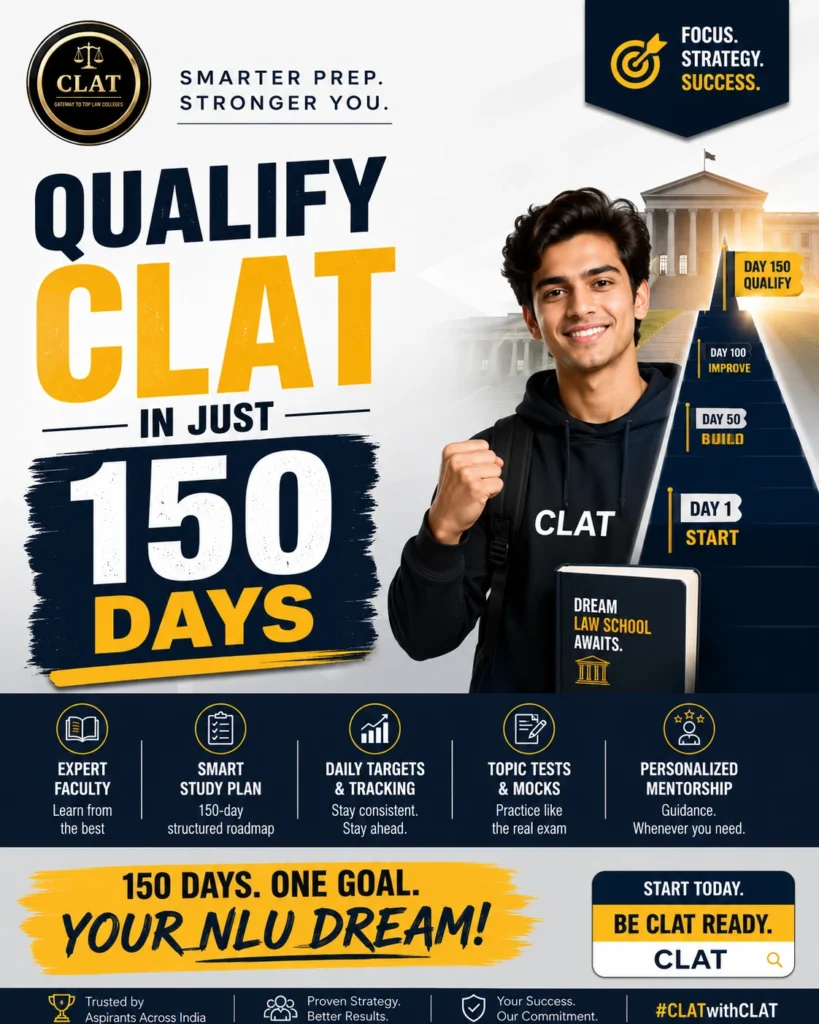
150-Day CLAT Plan
Daily (4–5 hours)
| Subject | Time |
|---|---|
| Current Affairs + Newspaper | 1 hour |
| Legal Reasoning | 1 hour |
| Logical Reasoning | 1 hour |
| English RC | 45 min |
| Quantitative Techniques | 30 min |
| Revision | 30 min |
Phase 1 (Days 1–50): Build Fundamentals
- Read one newspaper daily.
- Solve 2 English RCs daily.
- Practice 20–25 Legal Reasoning questions daily.
- Learn basic Quant topics:
- Percentages
- Ratio & Proportion
- Averages
- Data Interpretation
- Take 1 mock every week.
Phase 2 (Days 51–100): Intensive Practice
- Increase RC practice.
- Solve sectional tests.
- Revise monthly current affairs.
- Take 2 mocks every week.
- Maintain an error notebook.
Phase 3 (Days 101–150): Exam Mode
- 3 mocks every week.
- Focus on speed and accuracy.
- Revise all GK notes repeatedly.
- Analyze every mock thoroughly.
- Avoid new books and sources.
Weekly Targets
- 7 editorials
- 14–20 RC passages
- 150+ Legal questions
- 150+ Logical questions
- 3 Quant practice sets
- 1–3 mocks
Target Scores
- 60+ : Good start
- 75+ : Competitive
- 85+ : Strong NLU chance
- 95+ : Top NLU range (varies by year and paper difficulty)
June–October: 70% CLAT, 30% Boards
Daily Schedule (5–6 hours outside school)
- Current Affairs: 30 min
- Newspaper Reading: 30 min
- Legal Reasoning: 1 hour
- Logical Reasoning: 1 hour
- English RC: 45 min
- Quant: 30 min
- Board Subject Revision: 1–1.5 hours
Take 1–2 mocks per week and analyze every mistake. Starting mocks early is important.
November–CLAT Exam
80% CLAT, 20% Boards
- 3 mocks per week
- Daily GK revision
- Error notebook revision
- Maintain basic board preparation to avoid backlog
After CLAT
20% CLAT (if AILET/other exams), 80% Boards
Focus almost entirely on:
- NCERTs
- Sample papers
- Previous-year board papers
- Subject-wise revision
If You Are a Humanities Student
You have an advantage because:
- English helps both Boards and CLAT.
- Political Science improves Constitutional and Legal understanding.
- History and Current Affairs improve GK.
Common Mistake
Many students ignore boards completely for CLAT and then struggle later. Students on CLAT forums often advise maintaining steady board preparation throughout the year rather than leaving everything for February.
Target
- CLAT Mock Score by September: 70+
- CLAT Mock Score by November: 85+
- Board Percentage Goal: 85%+
What NOT to Do During the CLAT Exam
Many students lose 10–20 marks because of avoidable mistakes rather than lack of knowledge.
❌ Don’t spend too much time on one passage
- If a passage is difficult, mark it and move on.
- Come back later if time permits.
❌ Don’t start with your weakest section
- Begin with the section where you’re most comfortable.
- Build confidence and momentum early.
❌ Don’t attempt every question blindly
- CLAT has negative marking.
- Avoid random guessing.
❌ Don’t ignore the clock
- Keep checking time after every section.
- Aim to finish with 5–10 minutes left for review.
❌ Don’t panic if the paper seems difficult
- If it’s difficult for you, it’s difficult for everyone.
- Focus on accuracy rather than speed.
❌ Don’t spend all your time reading passages
- Read actively.
- Look for keywords, arguments, facts, and conclusions.
❌ Don’t change answers repeatedly
- Your first answer is often correct unless you find clear evidence otherwise.
❌ Don’t leave Quant for the end without practice
- Many students lose easy marks here.
- Attempt straightforward DI and arithmetic questions.
❌ Don’t skip mock-test analysis before the exam
- Learning from mistakes is more important than taking many mocks.
Exam-Day Mistakes
🚫 Studying new topics on exam day
🚫 Sleeping late the night before
🚫 Reaching the center late
🚫 Comparing preparation with other students before the exam
🚫 Panicking after seeing difficult questions
Golden Rule
Attempt smart, not maximum.
A student attempting 95 questions with 85% accuracy usually performs better than a student attempting 120 questions with 65% accuracy.
For a Top 5 NLU, your goal should be:
- Accuracy: 80%+
- Calmness under pressure
- Strong time management
These three factors often matter more than studying an extra 100 hours. 150 days CLAT Plan