Table of Contents
CLAT · AILET · Law Entrance
Lucknow · 2025–26
Strategy Guide · CLAT 2026
CLAT Without Maths:
Can You Still Qualify?
Spoiler: Yes — and thousands do it every year. Here’s the complete playbook to score 90+ in CLAT by dominating the four subjects you actually enjoy.
Updated: June 202510 min readGS + Law EntranceCLAT 2026
⚖️
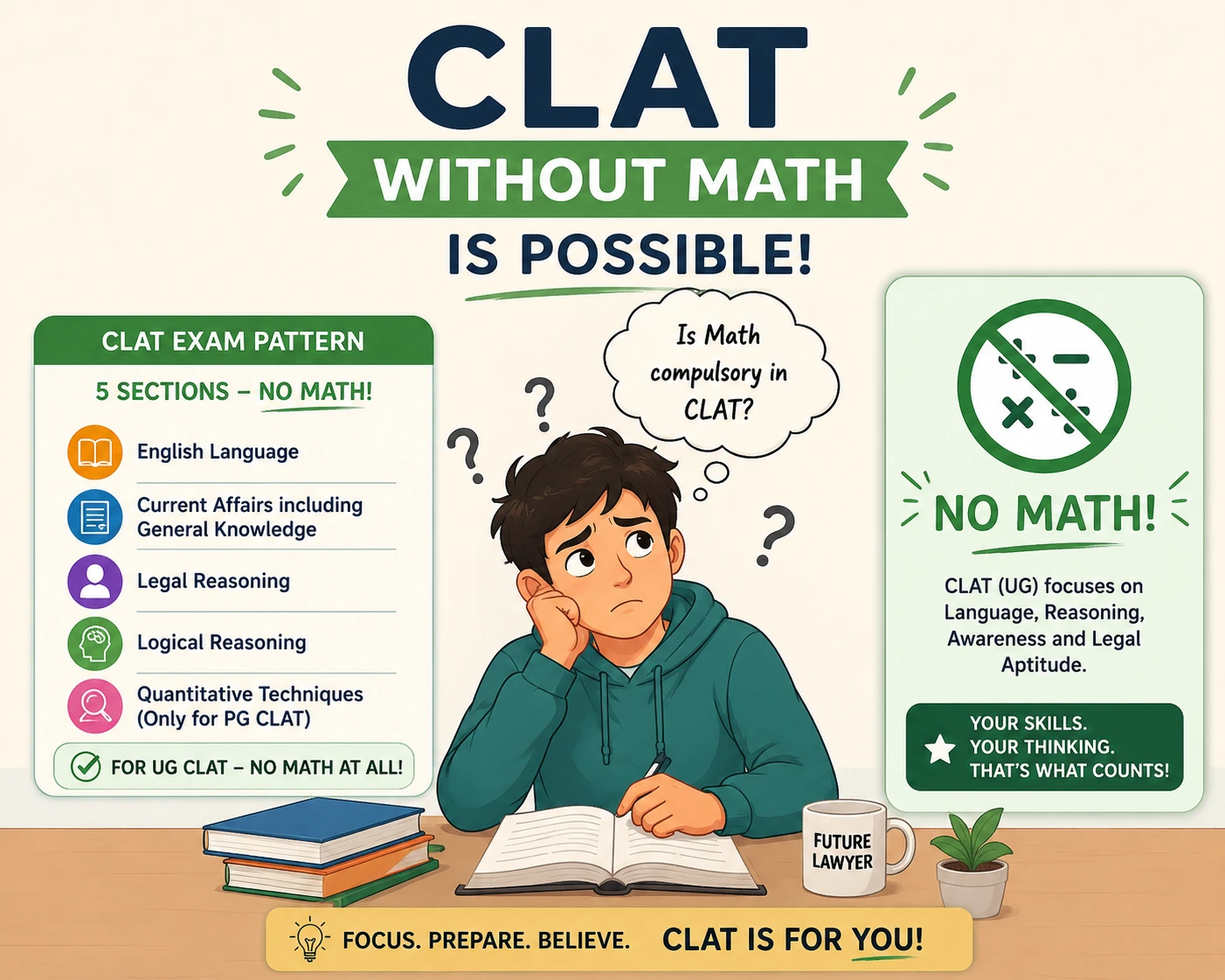
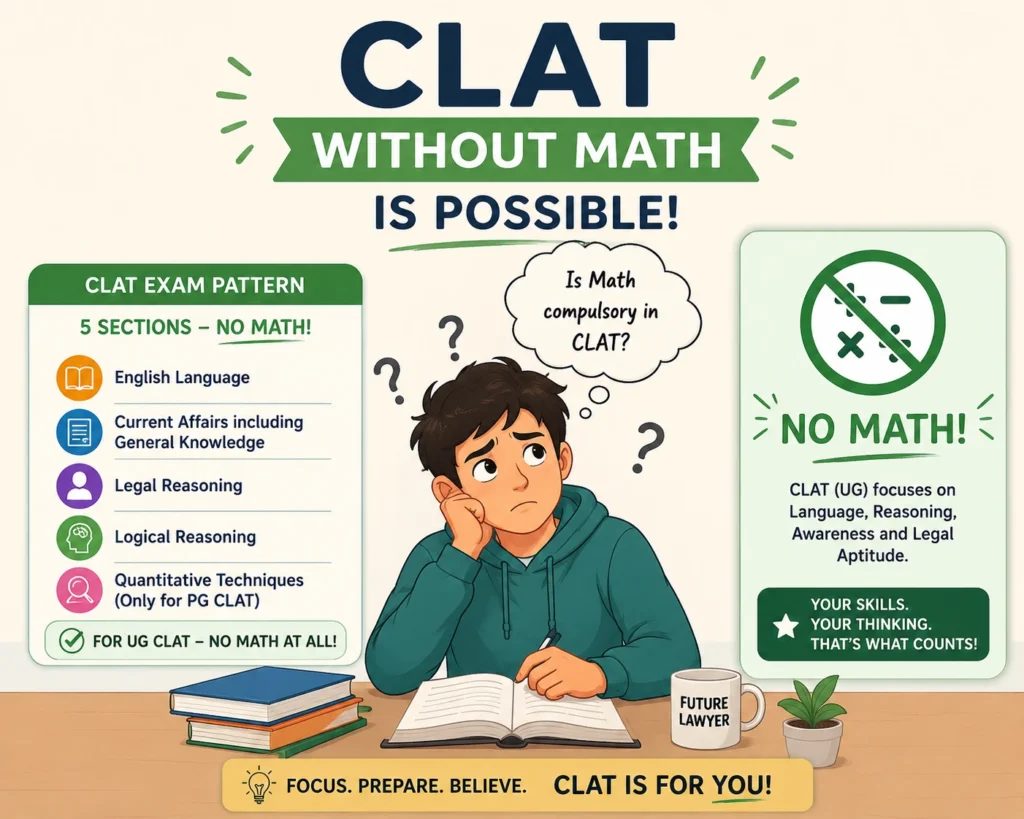
The Short Answer: Maths is NOT a barrier to cracking CLAT
Quantitative Techniques carries only 10% weightage in CLAT (approximately 13–15 questions out of 120). A student who scores 0 in this section but dominates English, Legal Reasoning, Logical Reasoning, and GK can still comfortably clear the cutoff for NLUs — including top-5 colleges.
Step 01 — Know Your Battlefield
CLAT 2026 Exam Pattern: The Real Picture
Before building a strategy, you must understand exactly how many marks are at stake in each section. The numbers will surprise you — Maths is the smallest section in CLAT.
| Section | Questions | Marks | % Weightage | Your Verdict |
|---|---|---|---|---|
| English Language | 28–32 | ~30 | 25% | High Priority ✓ |
| Current Affairs & GK | 35–39 | ~35 | 25% | High Priority ✓ |
| Legal Reasoning | 35–39 | ~35 | 25% | High Priority ✓ |
| Logical Reasoning | 28–32 | ~30 | 20% | Important ✓ |
| Quantitative Techniques | 13–17 | ~13 | 10% | Smallest Section |
| Total | 120 | 120 | 100% | – |
🔑 Key Insight
If you score 0 in Quantitative Techniques but get 85% correct in the remaining 4 sections (~90/107 marks), you still land around 75+ marks — well above the NLU cutoff in most years. The top NLUs typically see cutoffs between 75–90 out of 120.
Strategy
Step 02 — Run the Numbers
Score Simulation: Zero Maths, Still Qualifying
Let’s model a realistic scenario for a student who skips Quantitative Techniques entirely and focuses all energy on the four remaining sections.
📊 Target Score Breakdown (No Maths Strategy)
English Language (30 marks)Target: 24–27 marks → 80–90%
Current Affairs & GK (35 marks)Target: 26–30 marks → 75–85%
Legal Reasoning (35 marks)Target: 27–31 marks → 80–90%
Logical Reasoning (30 marks)Target: 22–26 marks → 73–87%
Quantitative Techniques (13 marks)Attempt: 4–6 easy questions → 4–5 marks
Projected Total103–119 / 120
Note: CLAT has −0.25 negative marking. Avoid random guessing in Maths. Even picking 4–5 doable questions smartly can add crucial marks.
Subject Strategy
Step 03 — Dominate Your 90%
Section-Wise Strategy for Non-Maths Students
📖
English Language
- Read The Hindu editorial daily — 20 min
- Focus on Reading Comprehension passages (2–3 passages, 5–6 Qs each)
- Practice vocabulary in context, not rote lists
- Grammar: active/passive, error spotting from past papers
- Target: 25+ out of 30
⚡
Current Affairs & GK
- Use a dedicated CLAT GK monthly magazine
- Cover: International Relations, Polity, Economy, Environment, Sports
- Make 1-page weekly revision sheets
- Static GK: Constitution basics, important judgements
- Target: 28+ out of 35
⚖️
Legal Reasoning
- No law knowledge required — only Principle-Fact-Conclusion logic
- Practice applying given principles to new facts strictly
- Do NOT use real-world legal knowledge — go by what the passage says
- Cover: Torts, Contracts, Crimes, Constitutional Law passages
- Target: 28+ out of 35
🧩
Logical Reasoning
- Argument analysis, inference, assumption — all passage-based
- Strengthen/Weaken argument type Qs are the most common
- Practice elimination method — 2 wrong options usually obvious
- Avoid syllogism traps: go by the passage, not general logic
- Target: 23+ out of 30
Maths Triage
Step 04 — Maths Triage

Which Maths Questions to Attempt (Even If You’re Weak)
Even non-maths students can pick up 4–6 easy marks from Quantitative Techniques. CLAT’s maths section is data interpretation and elementary arithmetic — not advanced algebra or calculus. Here’s what to attempt:
- ✓ Percentage-based DI (Data Interpretation)Bar graphs and pie charts with % values — just read and calculate. No formula needed, just careful reading. These are gifted marks.
- ✓ Ratio & ProportionCovered in any Class 7–8 textbook. CLAT level is school-basic. Spend 2 hours revising this chapter and gain 2–3 marks easily.
- ✓ Simple Average / MeanSum ÷ Count. That’s it. CLAT does not go beyond this level. Always attempt average-based questions.
- ✗ Skip: Profit/Loss complex chains, Time-Speed-DistanceThese require practiced formula knowledge. If you find them confusing, skip completely — wrong attempt costs 0.25 marks.
- ✗ Skip: Boats & Streams, Pipes & CisternsUnless you’ve practiced these specifically, avoid. Your time is worth more in Legal Reasoning re-checks.
Study Plan
Step 05 — The Roadmap
6-Month Study Plan: No Maths Track
M1
Month 1 — Foundation (July)
English: Grammar rules + RC basics. Legal: Understand Principle-Fact model with 50 practice sets. GK: Start monthly magazine. Maths: Revise % and Ratio only (4 hours total).
M2
Month 2 — Subject Depth (August)
English: 3 RC passages daily. Legal: Torts + Contract passages. Logical: Argument analysis practice. GK: Static Polity — Constitution basics, Article 12–35.
M3
Month 3 — Speed Building (September)
Start timed section tests (30 min per section). Legal: Criminal Law + Constitutional passages. GK: Environment, International bodies, Economy basics.
M4
Month 4 — Mock Integration (October)
Full-length mocks every Sunday. Target 100/120 in 4 non-maths sections. Error analysis diary — track recurring mistake patterns.
M5
Month 5 — Intensive Revision (November)
3 mocks per week. Revision of GK current affairs Sept–Nov. Legal: 200+ past year questions, timed. English: Vocabulary consolidation.
M6
Month 6 — Final Sprint (December)
Daily mocks + analysis. GK: December current affairs rapid fire. Identify your 4–5 easy Maths questions you’ll attempt in exam. Rest, revision, confidence.
Common Mistakes
Step 06 — Avoid These Traps
7 Mistakes Non-Maths CLAT Aspirants Make
- 1 Spending 1+ month “fixing” MathsThat time is worth 12–15 extra marks if invested in Legal Reasoning practice instead. Do the math (ironically).
- 2 Random guessing in Quantitative TechniquesWith −0.25 negative marking, guessing 10 questions randomly costs you 2.5 marks on average. Only attempt what you’re confident about.
- 3 Ignoring time management in Legal ReasoningLegal passages are long. Students read slowly and run out of time. Practice reading speed alongside comprehension from Month 2.
- 4 Using real legal knowledge in Legal ReasoningCLAT wants you to apply only what the passage says. Using your “real world” knowledge often leads to the wrong answer.
- 5 Neglecting Current Affairs after AugustCLAT 2026 will test events up to November 2025. Students who stop following news in October lose 5–7 easy marks.
- 6 Not practicing elimination in Logical ReasoningIn CLAT’s Logical Reasoning, you rarely “solve” — you eliminate. Practice spotting the two obviously wrong options first.
- 7 Skipping mock test analysisTaking mocks is useless without error analysis. Spend as much time reviewing a mock as taking it. This is where real improvement happens.
- CLAT 2026 UG Syllabus
- Consortium of NLUshttps://consortiumofnlus.ac.in › clat-2026 › ug-syllabus
Practice Questions

Test Yourself: CLAT Strategy MCQs
These questions test your understanding of CLAT’s exam pattern and strategy — useful for group discussions and interviews too.
Q1. What is the approximate weightage of Quantitative Techniques in CLAT 2026?
A) 25%
B) 10%
C) 20%
D) 15%
✅ Correct: (B) 10% — QT carries only ~13–15 questions out of 120. It is the smallest section in CLAT.
Q2. In CLAT Legal Reasoning, a student who has studied real law will always perform better than one who hasn’t. This statement is:
A) True — law knowledge is essential
B) False — answers are based only on passage principles
C) True — for Constitutional Law sections
D) Partially true — for Criminal Law only
✅ Correct: (B) — CLAT Legal Reasoning is entirely passage-based. You apply only the principle given in the passage, not external legal knowledge. Real law knowledge can even mislead!
Q3. A student attempting 10 unknown Maths questions by random guessing (no negative marking strategy) is likely to:
A) Gain 5+ marks on average
B) Break even with 0 marks
C) Lose marks due to −0.25 negative marking
D) Gain exactly 2.5 marks
✅ Correct: (C) — With 4 options, random guessing gives 25% hit rate. 10 guesses → ~2.5 correct (+2.5) and 7.5 wrong (−1.875). Net ≈ +0.625. But variance is high — any unlucky run costs marks. Best avoided unless you can eliminate 2 wrong options.
Q4. Which section gives the highest marks in CLAT 2026?
A) English Language
B) Current Affairs & GK
C) Legal Reasoning
D) Logical Reasoning
✅ Correct: (B) Current Affairs & GK — This section carries ~35 marks (25% weightage), tied with Legal Reasoning. Both are the highest-scoring sections. Students who crack GK score a significant advantage.
Subject Prioritisation
Master FrameworkWhy Strategic Study is Important for CLAT Aspirants | CLAT 2027
How to Prioritise Subjects in CLAT: The Complete Framework
Most CLAT aspirants make one costly mistake — they study all five sections equally. That approach sounds fair, but in a competitive exam with a 120-minute clock and five sections of wildly different value, equal effort does not produce equal returns. You must learn to invest your preparation time the way a smart investor allocates capital: maximum allocation where returns are highest, minimum where upside is capped.
The framework below is built on three criteria: marks at stake, effort-to-score ratio, and rank-impact. A section that is worth 35 marks and can be mastered with consistent daily practice is simply more valuable than a section worth 13 marks that requires years of specialised study. Once you internalise this, your entire preparation changes.
| Subject | Marks | Effort to Score 80%+ | Rank Impact | Priority Tier |
|---|---|---|---|---|
| Legal Reasoning | ~35 | Medium — needs daily practice | Very High | Tier 1 — Core |
| Current Affairs & GK | ~35 | Medium — needs consistency | Very High | Tier 1 — Core |
| English Language | ~30 | Low-Medium — skill compounds fast | High | Tier 2 — Build |
| Logical Reasoning | ~30 | Medium — needs pattern exposure | High | Tier 2 — Build |
| Quantitative Techniques | ~13 | High — for low return | Low | Tier 3 — Triage |
Tier 1 — Priority Subject
Legal Reasoning: Your Highest-Value Investment
Legal Reasoning is the section that separates serious CLAT aspirants from casual ones, and it is the subject where a disciplined non-law student can outperform a law-school kid simply by understanding the format. Every question follows the same three-part architecture: a Principle is given in the passage, a Fact situation is described, and you must arrive at a Conclusion by applying the principle strictly to the facts — nothing more, nothing less.
This is actually excellent news for science and commerce students who are unfamiliar with legal concepts. You are not being tested on what you know about Indian law. You are being tested on your ability to read carefully, reason logically, and resist the temptation to use outside knowledge. A Class 11 student who has never opened a law textbook can outperform an LLB aspirant who keeps second-guessing the passage with their “actual” legal knowledge.
The reason Legal Reasoning deserves the most preparation time — roughly 35–40% of your daily study hours — is twofold. First, it carries the highest marks alongside GK. Second, skill in this section compounds. Every set of practice questions you solve trains your brain to apply principle-to-fact logic faster and more reliably. Unlike GK, which requires ongoing memorisation, Legal Reasoning is a transferable skill that, once built, sustains itself.
📋 What to cover in Legal Reasoning
Focus areas: Law of Torts (negligence, defamation, nuisance), Contract Law (offer, acceptance, consideration, breach), Criminal Law (mens rea, actus reus, IPC basics), Constitutional Law (Fundamental Rights passages, PIL, writs). Practice minimum 5 passage-sets daily from Month 1. Use PYQs (Previous Year Questions) from CLAT 2015 to 2024 as your primary resource.
Tier 1 — Priority Subject
Current Affairs & GK: The Section That Rewards Consistency
Current Affairs is the most democratic section in CLAT. Unlike Legal Reasoning, which needs practice to develop a skill, or English, which rewards years of reading, GK is pure preparation. Every mark here is directly proportional to how much time you spend following news and revising static facts. There is no hidden trick. There is no skill barrier. There is only consistency.
CLAT tests current affairs from roughly January to November of the exam year, with a strong bias toward the last four to six months. This means your GK preparation has two distinct phases. The first phase — from July to September — is about building a static foundation: important constitutional provisions, international organisations, India’s treaty landscape, major Supreme Court judgements, and environment-related facts (Ramsar sites, national parks, biodiversity hotspots). These topics appear year after year in slightly varied forms.
The second phase — October onwards — is entirely current affairs driven. This is when you track major government schemes, diplomatic summits, economic data releases, important appointments, and national events. The passages in CLAT GK are comprehension-based, meaning you will read a short passage about a recent event and answer 3–5 questions from it. You do not need to memorise statistics to the decimal point. You need to understand the context, significance, and background of events deeply enough to handle inference-based questions.
Allocate 30–35% of your daily study time to GK. Do not treat this as light reading — treat it as active revision. Read a news item, close it, and write down three things you remember. This retrieval practice is what makes GK stick under exam pressure when your brain is also juggling Legal and Logical Reasoning simultaneously.
📋 GK Preparation Toolkit
Daily: Read one national newspaper (The Hindu or Indian Express) for 20 minutes, focusing on National, International, Economy, and Environment pages. Monthly: Subscribe to one CLAT-specific GK digest. Weekly: Attempt one GK mock with 35 questions to track retention. Quarterly: Revise static GK — Constitution, geography, economy basics — using a revision sheet you maintain yourself.
Tier 2 — Build Subject
English Language: Your Silent Rank Booster
English in CLAT is almost entirely Reading Comprehension. You will get 4–6 passages of roughly 400–500 words each, followed by 5–7 questions per passage. The questions test your ability to identify the main argument, infer tone and intent, find the meaning of words in context, and spot logical implications of what the author has said. There are no fill-in-the-blank grammar questions. There is no vocabulary list to mug up.
This makes English the most skill-compounding section in CLAT. Every hour you spend reading quality prose — newspaper editorials, legal commentaries, essays, or even quality fiction — directly improves your performance. Students who read regularly find that English becomes their lowest-effort, highest-return section by the time the exam arrives.
Dedicate 20–25% of your daily time to English, split between active reading and timed RC practice. Active reading means reading with attention to how the author builds an argument — what is stated, what is implied, what is assumed. Timed RC practice means attempting a full passage-set in 10–12 minutes and checking your accuracy. Speed and comprehension must grow together; one without the other is insufficient.
A specific note for students from Hindi-medium backgrounds: the English RC in CLAT uses formal, editorial-style prose, not conversational English. The vocabulary is academic but not obscure. Focus on understanding passage structure — introduction, argument, counterargument, conclusion — and you will find the questions much easier to navigate than they appear at first glance.
Tier 2 — Build Subject
Logical Reasoning: Think in Patterns, Not Problems
Logical Reasoning in CLAT is fundamentally different from the Logical Reasoning you may have seen in MBA entrance exams or competitive maths tests. There are no blood relations puzzles, no seating arrangements, no coding-decoding. CLAT’s Logical Reasoning is entirely argument-based and passage-based. You read a short paragraph making a claim or argument, and then answer questions about it: What assumption is the author making? Which of the following statements weakens this argument? What can be inferred from the passage?
The skill being tested here is critical thinking, not pattern solving. This is actually an advantage for students who are strong readers and who can think about ideas clearly. The best way to prepare is by categorising question types and developing a specific approach to each. The main question types are: Strengthening an argument, Weakening an argument, Identifying assumptions, Drawing inferences, Identifying logical flaws, and Evaluating the main conclusion.
Allocate 15–20% of your daily time to Logical Reasoning. The key practice principle is to always identify why an answer is correct, not just that it is. Two options in Logical Reasoning are usually obviously wrong, one is a tempting trap, and one is correct. Your job is to identify the trap — typically an answer that is true in the real world but goes beyond what the passage has actually said. Training yourself to spot this distinction is what separates 70% scorers from 90% scorers in this section.
Daily Time Allocation

What a Prioritised Study Day Looks Like
Theory is useful only when it translates into a daily schedule. Below is a model 6-hour study day for a non-maths CLAT aspirant, built entirely around the prioritisation framework above.
⏱ Model Daily Schedule (6 Hours)
Legal Reasoning — Practice Sets2 hrs 15 min → 37.5%
Current Affairs — Reading + Revision1 hr 45 min → 29%
English — RC Practice + Active Reading1 hr 15 min → 21%
Logical Reasoning — Question Sets45 min → 12.5%
Quantitative Techniques0 min on weekdays → selective weekends only
Total Daily Investment6 Hours — Zero Wasted on Weak Sections
On weekends, replace 45 minutes of Logical Reasoning with a Maths revision session covering only percentages, ratios, and DI graphs. That is the entirety of your Maths preparation. Two hours per week, on weekends only, targeting 4–6 marks. Do not allow this to creep into your weekday schedule.
🧠 The Prioritisation Principle in One Line
Every hour you spend on a subject should be proportional to what it can realistically deliver at your current skill level — not to what feels “balanced” or “fair.” CLAT rewards asymmetric effort. Students who master Legal Reasoning and GK at 85%+ accuracy while maintaining 75%+ in English and Logical Reasoning will comfortably clear the cutoff, even scoring near zero in Maths. This is not a workaround — it is the optimal strategy.
Conclusion
The Bottom Line
CLAT is a language, logic, and law exam — not a mathematics exam. The Quantitative Techniques section exists to test basic numeracy, not advanced mathematical ability. A student who excels in English comprehension, logical thinking, and is well-informed about current affairs has every tool needed to crack CLAT and join a top NLU.
The aspirants who struggle with Maths and still crack CLAT share one trait: they don’t waste energy fighting their weakness. Instead, they convert their strengths into an overwhelming advantage. 90% of the exam is yours to own — claim it.
📌 Quick Revision Capsule
QT = 10% only | Legal Reasoning is passage-based, no law knowledge needed | Random guessing in Maths costs marks | Focus: English + GK + Legal + Logical = 90% of paper | Even 4–5 easy Maths marks can make a difference at the cutoff margin — CLAT · AILET · SLAT · LSAT India
Content mapped to CLAT 2026 Consortium Pattern · For educational use only