CLAT Prep Series · General Knowledge & Current Affairs · 2026
Complete Strategy Guide
Table of Contents
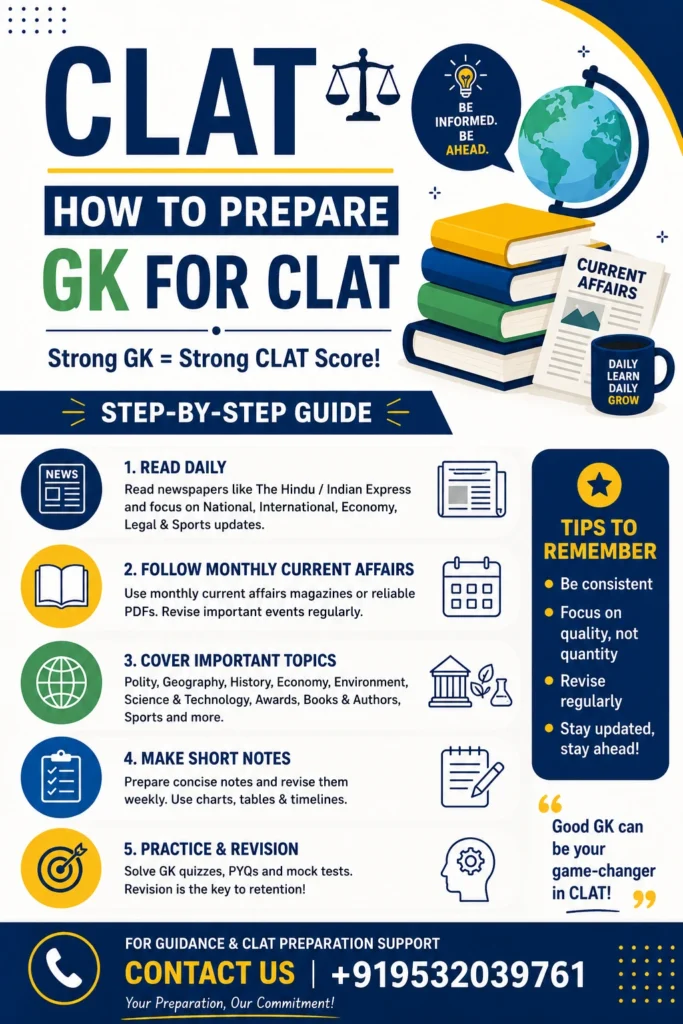
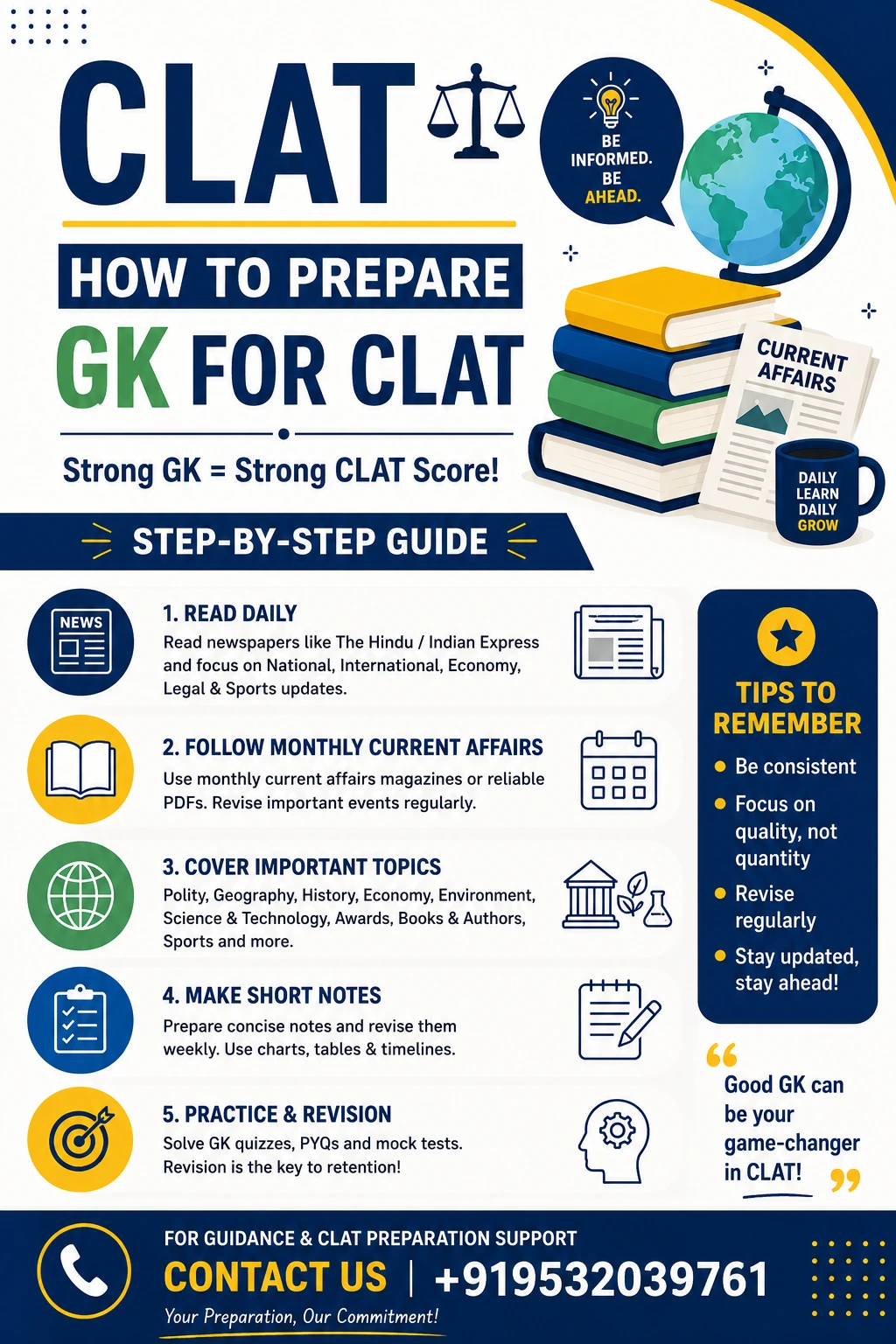
How to Prepare GK for CLAT
From daily newspaper reading to revision cycles — everything you need to score 28+ in the GK section of CLAT 2026.How to Prepare GK for CLAT 2026
📖 15 min read🎯 CLAT 2026📊 GK: 25 Questions✅ MCQs Included

Section 01 — Know the Pattern
First, Understand What CLAT GK Actually Tests
The General Knowledge section in CLAT is unlike most competitive exams. CLAT does not ask isolated factual recall questions like “Who is the CM of XYZ state?” Instead, it presents reading comprehension passages based on current affairs, and asks you to answer questions from the passage — testing your ability to understand, infer, and apply.
This is both good news and bad news. Good news: you don’t need to mug up thousands of facts. Bad news: if you haven’t followed the news contextually, you’ll struggle to even understand the passage.
Key Insight: CLAT GK passages are drawn from quality news sources — The Hindu, Indian Express, The Wire, Down to Earth. Your preparation must mirror these sources. Awareness + Reading Comprehension = Success.
| Parameter | Details |
|---|---|
| Total Questions | 25–30 (varies slightly each year) |
| Question Type | Passage-based MCQs (4–5 questions per passage) |
| Marking Scheme | +1 for correct, −0.25 for wrong |
| Expected Attempts | 20–24 (accuracy matters more than speed) |
| Good Score | 18–22 out of 25–30 |
Section 02 — Topic Coverage
What Topics Does CLAT GK Cover?
Based on past CLAT papers (2019–2024), here is the realistic topic breakdown. Prioritise the HIGH-weightage areas first.
🔴 Highest Weightage
National & International Affairs
- India’s foreign policy & bilateral ties
- Major summits (G20, SCO, QUAD, ASEAN)
- International conflicts & diplomacy
- UN agencies & global governance
- India’s trade deals (FTAs, CEPAs)
🟡 High Weightage
Constitutional & Legal Affairs
- Supreme Court landmark judgments
- New laws & bills passed in Parliament
- Constitutional amendments
- Tribunals, regulatory bodies
- Election Commission decisions
🟢 Moderate Weightage
Economy & Business
- Union Budget highlights
- RBI policies & repo rate
- GDP data, Economic Survey
- PLI schemes, startup ecosystem
- India’s ranking in global indices
🔵 Moderate Weightage
Environment & Science
- Climate summits (COP, Paris Agreement)
- Species in news, Ramsar sites
- ISRO missions, India’s space policy
- Health/pandemic-related policy
- Technology regulations & AI policy
🔴 High Weightage
Sports & Awards
- Olympics, Asian Games, World Cups
- India’s medal winners
- Bharat Ratna, Padma Awards
- Nobel Prize, Booker Prize winners
- International sports bodies
🟡 Moderate Weightage
Governance & Schemes
- Flagship central schemes
- State-centre relations
- NITI Aayog initiatives
- Appointments (CJI, CAG, governors)
- Government reports & committees
| Topic Area | Expected Questions | Priority | Time Period to Cover |
|---|---|---|---|
| National & International Affairs | 8–10 | Very High | Last 12–15 months |
| Legal & Constitutional Affairs | 5–7 | Very High | Last 12 months |
| Economy & Business | 3–5 | High | Last 6–12 months |
| Environment & Science/Tech | 3–5 | High | Last 12 months |
| Sports & Awards | 2–4 | Moderate | Last 12 months |
| Static GK (History, Geography, Polity) | 1–3 | Low | Standard Class 10–12 |
Section 03 — Best Resources
The Only Sources You Need for CLAT GK
Don’t waste time with random GK apps or outdated books. CLAT passages are drawn from quality journalism. Read what CLAT reads.
📰 Newspapers (Primary Source — Daily)
Must Read
The Hindu Focus: National, International, Editorial
Must Read
Indian Express Focus: Polity, Explained page
Recommended
Hindustan Times Focus: Concise national news
Selective
Business Standard Focus: Economy & Budget
🌐 Online Sources & Apps
Environment
Down to Earth Ecology, Climate, Species
Legal News
LiveLaw / Bar & Bench SC judgments, new laws
Monthly Digest
Lawctopus GK Notes CLAT-specific summaries
Current Affairs
Drishti IAS (English) Hindi + English both available
Pro Tip: Don’t read every newspaper cover to cover. Read The Hindu’s front page, national, international, and editorial every day. That’s 30–40 minutes max. Supplement with a monthly GK magazine or CLAT-specific digest.
Section 04 — Month-wise Strategy
The 6-Month GK Preparation Roadmap
1
Month 1–2: Build the Habit + Cover Past 12 Months
Start reading The Hindu and Indian Express daily. Simultaneously, cover the past 12 months of current affairs using monthly PDFs or CLAT-specific GK compilations. Make a topic-wise notebook: one section each for national affairs, international, legal news, economy, environment, sports.
2
Month 3–4: Deepen Coverage + Passage Practice
By now you should have strong contextual awareness. Start practicing CLAT-style passage-based questions daily. Use previous years’ CLAT GK passages (2019–2024). Focus on inference and application questions — not just factual recall. Start noticing how passages are structured.
3
Month 5: Consolidate + Revise Notes
Revise your topic-wise notebook at least twice. Make a “rapid revision sheet” with top 50 events per topic area. Focus on events/judgments/schemes that have CLAT-passage potential — i.e., they involve legal, constitutional, social, or environmental dimensions.
4
Month 6 (Final): Mock Tests + Last 3 Months’ Affairs
Take at least 8–10 full-length CLAT mock tests. Analyse your GK accuracy per passage. Cover the last 3 months’ current affairs intensively, as these are most likely to appear. Don’t study new topics — revise what you know.
Section 05 — Daily RoutineWhy Strategic Study is Important for CLAT Aspirants | CLAT 2027
Ideal Daily GK Study Routine for CLAT Aspirants
📅 Daily GK Schedule (1.5 hours total)
6:30–7:15
Morning Newspaper Reading — The Hindu front page, National, International, and Edit page. Note 3–5 important events in your GK diary with a one-line context.
7:15–7:30
Legal News (10 min) — Check LiveLaw or Bar & Bench for any Supreme Court judgment or important legal development. Note the issue, parties, and holding in 2–3 lines.
Evening
Passage Practice (20 min) — Solve 1 CLAT-style GK passage (4–5 questions). Analyse wrong answers. Build the habit of reading and inferring rather than just factual recall.
Night (Weekly)
Weekly Revision (Sunday) — Every Sunday, revise the week’s GK diary entries. Convert them into 5–10 bullet points per topic. Update your rapid revision sheet.
Section 06 — Common Mistakes
7 Mistakes CLAT Students Make in GK Preparation
- Reading GK like a quiz game: CLAT is not KBC. Don’t memorise isolated facts. Understand events in context — their cause, stakeholders, and implications.
- Ignoring the legal angle: Since CLAT is a law entrance exam, always ask “what is the legal/constitutional dimension of this news?” That’s how passages are framed.
- Skipping environment news: Environment is consistently tested in CLAT. Down to Earth and The Hindu’s ecology coverage are must-reads.
- Not practicing passage-based questions: Many students read newspapers but never practice the actual CLAT GK question format. Passage comprehension speed and accuracy need separate practice.
- Over-relying on monthly magazines alone: Monthly magazines give you the facts but not the depth. Supplement with original articles for major events.
- Neglecting international affairs: India’s global ties, trade deals, geopolitical developments — these form a large chunk of CLAT passages. Don’t skip them.
- Starting too late: GK is not a section you can cram in 2 weeks. It requires consistent daily engagement for at least 4–6 months.
Section 07 — Practice MCQs
CLAT-Style GK Practice Questions
These MCQs are framed in the CLAT passage-based format. Try each before revealing the answer.
Q1. India recently signed the CEPA (Comprehensive Economic Partnership Agreement) with which country, marking its first such agreement with a Gulf nation?
- (A) Saudi Arabia
- (B) UAE (United Arab Emirates)
- (C) Qatar
- (D) Oman
Answer: (B) UAE. India-UAE CEPA came into force in May 2022, covering goods, services, and investment. It was India’s first FTA with a Gulf country. Under it, India got zero-duty access for over 90% of its exports to the UAE.
Q2. The Supreme Court’s judgment in Justice K.S. Puttaswamy (Retd.) v. Union of India (2017) is historically significant because it:
- (A) Upheld the constitutional validity of the Aadhaar Act in its entirety
- (B) Declared that the right to privacy is not a fundamental right
- (C) Unanimously recognised the right to privacy as a fundamental right under Article 21
- (D) Struck down the Information Technology Act, 2000
Answer: (C). A 9-judge constitution bench unanimously held that privacy is an intrinsic part of Article 21 (Right to Life and Personal Liberty). This overruled earlier judgments in M.P. Sharma (1954) and Kharak Singh (1962).
Q3. Which international climate mechanism allows countries to trade carbon credits for emissions reductions, and is regulated under Article 6 of the Paris Agreement?
- (A) Kyoto Protocol CDM
- (B) REDD+ Framework
- (C) Article 6.4 Mechanism (Sustainable Development Mechanism)
- (D) Green Climate Fund
Answer: (C). Article 6 of the Paris Agreement governs international carbon markets. Article 6.4 establishes a new UN-supervised carbon crediting mechanism to replace the CDM under Kyoto Protocol. India has set up its own Carbon Credit Trading Scheme (CCTS) under the Energy Conservation (Amendment) Act, 2022.
Q4. India’s GDP ranking as per IMF’s April 2026 World Economic Outlook placed India at which position among world economies?
- (A) 3rd largest
- (B) 4th largest
- (C) 5th largest (slipped from 4th due to Japan’s yen recovery)
- (D) 6th largest
Answer: (C). As per IMF April 2026 data, India’s nominal GDP was around $3.9 trillion, ranking it 5th globally after the USA, China, Germany, and Japan. The yen’s appreciation helped Japan reclaim 4th rank.
Q5. The Ramsar Convention relates to the conservation of:
- (A) Tropical rainforests and biodiversity hotspots
- (B) Wetlands of international importance
- (C) Marine protected areas and coral reefs
- (D) Migratory birds and their habitats
Answer: (B). The Ramsar Convention (1971) is an international treaty for the conservation and sustainable use of wetlands. India now has 85+ Ramsar sites — the highest number in Asia. Notable recent additions include Nanjarayan Bird Sanctuary (Tamil Nadu) and Thol Wildlife Sanctuary (Gujarat).
CLAT 2026 UG Syllabus
Consortium of NLUshttps://consortiumofnlus.ac.in › clat-2026 › ug-syllabus
5 Golden Rules for CLAT GK Preparation
Rule 1: Quality over quantity. 30 minutes of focused, analytical newspaper reading beats 2 hours of passive GK app scrolling.
Rule 2: Always note the legal angle of every news event — who has the jurisdiction, what rights are involved, what court/law applies.
Rule 3: Revise weekly, not just before exams. GK is a retention game. Short, frequent revision beats last-minute cramming.
Rule 4: Practise reading comprehension on news passages separately. Speed + inference accuracy = your CLAT GK score.
Rule 5: Cover the last 14–16 months of current affairs. CLAT passages almost never go beyond this window.
CLAT Prep Series · GK & Current Affairs · All rights reserved